Choosing the Right Commercial Production Studios for Your Project
When planning a high-quality live stream or recorded video project, understand the distinction between relying solely on streaming software and leveraging a dedicated commercial production studio. While powerful software applications have democratized content creation, professional facilities offer a robust infrastructure designed for demanding, high-stakes productions.
Live Streaming Studio vs Software-Only Encoders
For many content creators, desktop or cloud-based streaming software like OBS Studio, Meld Studio, or StreamYard provides incredible flexibility and cost-efficiency. These applications allow users to capture, mix, and encode video and audio using their personal computer hardware. They are excellent for solo streamers, small podcasts, or educational sessions where the environment can be controlled and technical demands are within the capabilities of consumer-grade equipment.
However, commercial production studios elevate the entire process. Instead of relying on a general-purpose computer to handle encoding—where unexpected operating system updates, thermal throttling, or background processes can cause dropped frames—studios utilize dedicated hardware reliability and specialized encoders that offer superior performance and stability.
They provide a controlled environment where factors like signal routing, frame synchronization, and sound isolation are meticulously managed, ensuring a pristine output. This distinction is crucial for broadcasts where quality, consistency, and resilience against technical glitches are paramount. Dedicated video processing hardware handles heavy multi-camera computations without the system degradation often seen in software-only setups.
Spatial Layout and Acoustic Soundproofing
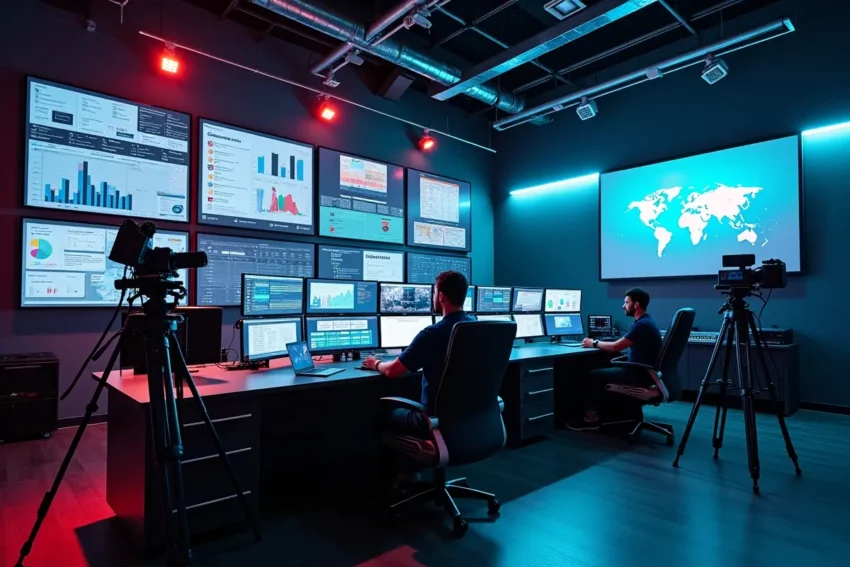
A significant advantage of commercial studios lies in their physical environment. These facilities are purpose-built with specific production needs in mind. The spatial layout is designed to accommodate multiple cameras, intricate sets, green screens, and the seamless movement of talent and crew without compromising shot composition or technical access. Proper spatial geometry prevents visual clutter and allows for precise camera sightlines, crane maneuvers, and multi-angle coverage.
Crucially, studios invest heavily in acoustic treatment and sound isolation. This prevents external noise interference from traffic, mechanical HVAC systems, or adjacent rooms, while eliminating internal room echoes and standing waves. Achieving a low noise criterion (NC) rating requires decoupled floating floors, double-wall construction, and specialized low-velocity HVAC ducting with inline silencer boxes.
Every element ensures that all audio captured is crystal clear and professional-grade. From sound-dampening materials on walls to isolated control rooms, every element contributes to an environment where audio quality can be meticulously controlled. Similarly, overhead professional lighting grids with DMX and Art-Net control provide consistent, high-quality illumination that can be precisely adjusted for various scenes and moods, a level of control rarely achievable outside a dedicated facility.
Key Features and Services in Commercial Production Studios
Commercial production studios offer a suite of advanced features and services that go far beyond what individual streaming software can provide. These capabilities are designed to handle complex productions, ensure broadcast-quality output, and manage intricate technical workflows.
Key Equipment Needed in Commercial Production Studios
A professional studio is equipped with specialized hardware that forms the backbone of any high-quality broadcast. This includes multi-input 4K switchers that allow for seamless transitions between numerous camera feeds, lower-third graphics, playback channels, and pre-recorded content. Unlike software-based switching, dedicated hardware switchers offer superior processing power, zero-frame latency, hardware keyers for pristine chroma keys, and greater operational reliability under pressure.
For encoding, studios employ dedicated hardware encoders equipped with hardware ASICs. These devices are specifically designed to compress video efficiently using H.264 or HEVC codecs at high bitrates, offloading the intensive processing from general-purpose computers. This ensures stable, high-bitrate streams without impacting other production elements. Audio is managed through sophisticated digital audio mixers operating on Dante or AES67 audio-over-IP networks, providing granular control over multiple wireless microphones, sound effects, and music tracks, complete with parametric EQ, dynamic compression, and automated noise suppression.
Finally, the use of professional broadcast cameras (including PTZ cameras, cinema cameras, and studio cameras with broadcast lenses) connected via 12G-SDI or fiber optics ensures exceptional image quality, accurate color science, genlock synchronization, and wide dynamic range, which are fundamental for a polished final product.
Hybrid Broadcasts and Remote Production Workflows
Modern commercial studios are adept at integrating remote elements into live productions, facilitating what we call hybrid broadcasts. This often involves seamlessly bringing in remote callers, remote panelists, or international presenters from around the globe, ensuring their audio and video quality meets rigorous broadcast standards. Tools like vMix Call, Zoom ISO, or dedicated hardware video transceivers can be integrated directly into the studio’s matrix routers, while the studio environment handles the complex routing, color correction, and mix-minus audio generation so remote speakers hear echo-free audio.
Studios also offer ISO recording, meaning each raw camera feed, graphics layer, and audio track is recorded independently to high-speed storage arrays alongside the master program output. This provides immense flexibility for post-production, allowing editors to re-cut, re-grade color, or correct performance issues without affecting the initial live broadcast.
For interactive or time-sensitive events, studios prioritize low-latency feeds and direct teleprompter feedback loops to ensure real-time audience engagement and smooth Q&A interaction. Furthermore, many studios leverage cloud video infrastructure and media asset management platforms for efficient content distribution, instant archiving, and remote post-production access, providing a global reach and robust backup solutions.
How to Assess Technical Capabilities Before Hiring
Selecting the right commercial production studio requires a thorough assessment of their technical capabilities and operational procedures. It’s not just about the equipment they have, but how they manage it, maintain signal integrity, and integrate hardware into a cohesive broadcast workflow.
Budget Considerations for Commercial Production Studios
Understanding the financial aspects is crucial when engaging a commercial studio. Studios typically operate on day rates or half-day rates, which cover the use of the physical facility and a baseline equipment package for a set period. However, it’s important to inquire about potential technical add-ons. These might include specialized gear (e.g., teleprompters, motion control rigs, wireless video transmitters, or specialty lenses), additional control rooms, or specific software licensing for custom interactive graphics.
If your project requires editing, multi-track audio mixing, or color grading after the live event wraps, discuss post-production fees early in the planning stage. Many studios offer comprehensive post-production packages in-house, providing a streamlined workflow from live recording to final polished delivery.
Crucially, factor in production staffing costs for experienced specialists—such as Technical Directors (TD), Audio Engineers (A1), Video Operators (V1), Lighting Directors (LD), and Graphics Operators—who bring invaluable expertise, split-second problem-solving skills, and operational calm to your project. For organizations planning premium content events, investing in a studio with a proven track record for reliability and high-quality delivery is often a non-negotiable part of the budget, ensuring the production meets the highest industry standards.
Infrastructure and Bandwidth Redundancy Requirements
For any live broadcast, the underlying network and power infrastructure is paramount. A top-tier commercial studio will feature bonded connectivity, combining multiple ISP connections—such as dedicated enterprise fiber lines paired with low-latency cellular or satellite backups—to create a single, highly reliable uplink. This hardware redundancy ensures that even if a primary fiber line experiences an unexpected physical cut, the live broadcast remains completely uninterrupted without dropping frames or breaking connections.
Furthermore, a studio should boast a robust gigabit uplink or higher symmetrical bandwidth pipe, providing ample headroom for uncompressed high-definition or 4K streams sent to multiple destinations simultaneously. Power stability is another critical factor; studios often maintain online Uninterruptible Power Supply (UPS) battery banks coupled with automatic transfer switch backup generators to prevent power spikes or utility blackouts from disrupting a live broadcast.
For internal signal routing, many modern facilities utilize NDI infrastructure or SMPTE ST 2110 standards, allowing for uncompressed, low-latency video and audio transmission over standard IP networks, which significantly enhances signal routing flexibility and system scalability within the studio environment.
Frequently Asked Questions About Commercial Video Production
We often encounter common questions from clients transitioning from basic desktop streaming setups to professional studio productions. Here are some of the most frequent inquiries regarding workflow, hardware, and delivery:
What is the difference between client-side software encoders and full production facilities?
The primary difference lies in scale, hardware reliability, and total signal control. Client-side streaming software encoders (like OBS Studio, StreamYard, or Meld) are applications that run on a standard computer, utilizing its general-purpose CPU and GPU for video capture, scene composition, and encoding. They are flexible, accessible, and cost-effective for individual use, but they remain vulnerable to hardware bottlenecks, OS background tasks, and thermal constraints.
Full production facilities, on the other hand, offer dedicated hardware processing across every layer of the signal chain—from hardware switchers and dedicated video encoders to broadcast-grade digital audio consoles. They provide a controlled physical staging environment equipped with calibrated lighting rigs, sound-isolated acoustic architecture, and dedicated control rooms. The studio engineering team handles all aspects of production control and signal management, ensuring broadcast-grade quality, multi-layer redundancy, and bulletproof stability that software-only setups cannot replicate.
How much internet bandwidth is needed for a live studio broadcast?
For a professional live studio broadcast, the critical metric is stable, symmetrical upload throughput, rather than standard consumer download speed. While exact bandwidth requirements vary based on resolution, frame rate, encoding codec (H.264 vs HEVC), and the number of simultaneous stream outputs, a studio typically reserves a dedicated upload capacity of at least 20-50 Mbps for a single 1080p stream, and 100+ Mbps for 4K or multi-bitrate delivery.
Many studios utilize adaptive bitrates and multi-rate encoding to deliver the best possible visual quality to viewers on varying device connections. Protocols like SRT transport (Secure Reliable Transport) and Zixi are frequently employed for their advanced error correction and encryption, guaranteeing pristine low-latency video over public internet links. Crucially, professional studios maintain redundant connections (such as dual ISP fiber paths combined with bonded cellular fallbacks) to eliminate any single point of network failure during a live show.
Can commercial studios manage multi-destination streaming directly?
Yes, absolutely. Commercial studios are purpose-built to handle multi-destination streaming (simulcasting) efficiently and reliably across multiple video platforms. Instead of straining local network upload limits by pushing separate stream encodes to each destination from local hardware, studios leverage high-capacity cloud distribution architecture and media transit nodes.
The studio transmits a single ultra-high-quality master stream to a cloud ingest server, which then replicates and re-transmits the stream to platforms like YouTube, Twitch, LinkedIn, Facebook, Kick, or custom private RTMP enterprise servers simultaneously.
Studios configure precise RTMP routing (or modern SRT/RIST pipelines) to guarantee every stream destination receives the exact video specs required. They can manage multi-platform feeds with tailored encoding profiles, dynamic aspect ratios, and custom branding for specific platforms, ensuring optimal visual performance and maximum audience reach across every channel.
Conclusion
Choosing the right commercial production studio is a strategic decision that significantly impacts the overall quality, authority, and success of your live or recorded video project. By understanding the profound advantages of a dedicated facility over basic streaming software, you can make an informed choice that directly aligns with your creative vision and technical requirements.
From meticulous facility evaluation and clear definition of your total production scope to auditing bandwidth redundancy and ensuring robust broadcast delivery, each step plays a vital role in executing a flawless show. A professional studio provides the controlled acoustic environment, enterprise hardware, and veteran crew necessary for seamless technical execution, allowing your team to focus entirely on content and presentation while experts handle the complex logistics of bringing your project to life.