Sourcing High-Quality Materials in Stainless Steel Distribution
In today’s advanced manufacturing world, precision and material integrity are vital. This is especially true for stainless steel. It is a critical material in many industries, from aerospace to medical devices. The final product’s performance and longevity depend directly on the quality of the raw material and its subsequent processing.
How do we ensure that every piece of stainless steel meets rigorous specifications? This applies from its origin to the final cut. Our guide will explore this careful journey of sourcing and processing this important material.
We will cover the strict standards that govern modern stainless steel distribution. We will also examine the transformative role of advanced cutting technologies, particularly pressurized water cutting. These methods contribute to unparalleled material efficiency and precision. Ensuring we provide high-quality stainless steel means more than just selecting the right alloy; it demands superior processing techniques that maintain the material’s inherent properties without compromise.
Sourcing Standards in Modern Stainless Steel Distribution
The journey of high-quality stainless steel begins long before it reaches the fabrication floor. It starts with stringent sourcing standards, where every step, from mill production to distribution, is meticulously controlled. Our focus on quality ensures that the stainless steel we distribute meets or exceeds industry expectations for performance, durability, and safety. This involves a deep understanding of material traceability, alloy certification, and technical specifications.
We prioritize materials accompanied by comprehensive mill test reports (MTRs), which serve as a birth certificate for each batch of stainless steel. These reports detail the chemical composition, mechanical properties, and compliance with various industry standards. Whether it’s an austenitic grade known for its corrosion resistance, a martensitic alloy valued for its hardness, or a duplex stainless steel offering a balance of strength and ductility, verifying these specifics is paramount.
Material Traceability and Alloy Certification
Material traceability is the backbone of reliable stainless steel distribution. It allows us to track every plate, sheet, or bar back to its original melt, ensuring complete transparency and accountability. We employ positive material identification (PMI) techniques to verify alloy composition on-site, cross-referencing against ASTM standards and specific heat numbers.
This meticulous alloy verification process is crucial, particularly for applications where corrosion resistance and mechanical integrity are non-negotiable. For instance, in corrosive environments, even slight deviations in chromium or nickel content can significantly impact the material’s long-term performance. Our commitment to these verification steps safeguards the integrity of every component our clients produce.
Technical Specifications in Stainless Steel Distribution
Beyond chemical composition, the physical and mechanical properties of stainless steel are critical. We meticulously check for tensile strength, which dictates how much stress the material can withstand before deforming or breaking. Surface roughness is another key specification, especially for applications requiring hygienic surfaces or specific aesthetic finishes. Gauge uniformity ensures consistent thickness across a material, vital for precision fabrication and avoiding potential weak points.
We also assess hardness grading, dimensional tolerances, and other mechanical properties. These technical specifications collectively determine the material’s suitability for various manufacturing processes and its performance in its intended application. Adhering to these rigorous standards from the outset minimizes waste, reduces rework, and ultimately delivers a superior end product.
Advanced Cold Cutting and Processing Capabilities
Once the stainless steel arrives, its transformation into a usable component demands cutting-edge processing techniques. Traditional methods, often involving heat, can compromise the material’s integrity. This is where pressurized water cutting, specifically abrasive waterjet technology, emerges as a superior solution, particularly for metals like stainless steel.
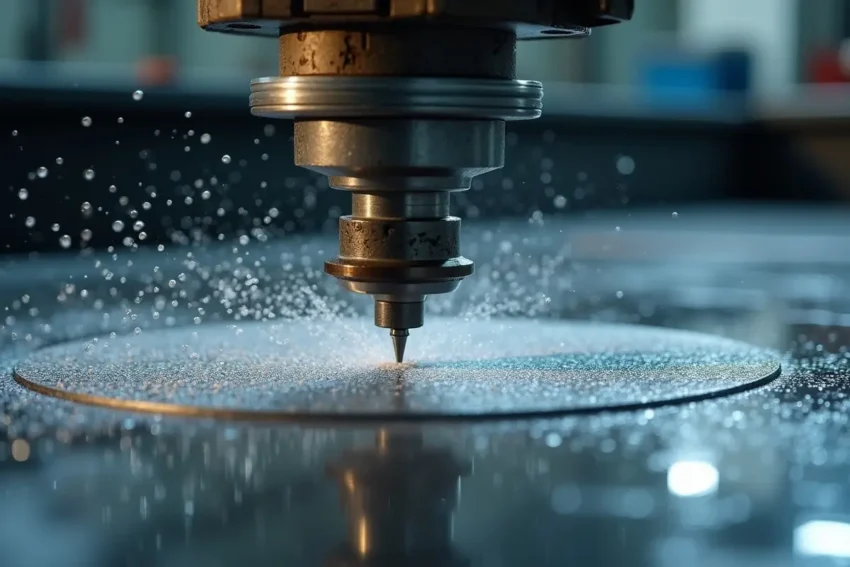
At its core, waterjet cutting harnesses the immense power of ultra-high-pressure water. This water is forced through a tiny orifice, creating a supersonic stream that can reach speeds up to Mach 3, or around 2,500 feet per second (760 m/s). When this stream is directed at a material, it erodes it with incredible precision. For softer materials, pure waterjet is sufficient. However, for cutting hard metals like stainless steel, an abrasive substance is introduced into the water stream, transforming it into an abrasive waterjet.
Modern waterjet systems operate at pressures typically ranging from 20,000 psi to 90,000 psi, with some ultra-high-pressure pumps reaching up to 100,000 psi (690 MPa). This remarkable pressure, combined with the abrasive, allows the jet to slice through even the toughest alloys with ease.
Pressurized Water Jet Mechanics and Abrasive Integration
The heart of an abrasive waterjet system lies in its pump and cutting head. Two primary types of pumps are commonly used: intensifier pumps and direct-drive pumps. Intensifier pumps use hydraulic oil to drive a piston, which in turn pressurizes water to extreme levels, often reaching 60,000 psi or even 90,000 psi. Direct-drive pumps, conversely, use a crankshaft to directly drive plungers that pressurize the water. While direct-drive pumps might have a lower initial cost, intensifier pumps often offer a lower long-term cost of ownership due to less maintenance.
Once pressurized, the water travels to the cutting head. Here, it passes through a tiny jewel orifice, typically made of sapphire or diamond, which forms the coherent, high-velocity stream. For abrasive cutting, this pure water stream then enters a mixing chamber. In this chamber, a carefully metered amount of abrasive material, most commonly garnet (often 80 mesh), is introduced.
The high-velocity water accelerates the abrasive particles, and this abrasive-laden jet then exits through a durable tungsten carbide nozzle, focusing its immense cutting power onto the workpiece. This mechanical sawing action, powered by the accelerated abrasive, is what enables the waterjet to cut through hard metals without generating significant heat.
Thermal Integrity and Eliminating the Heat-Affected Zone
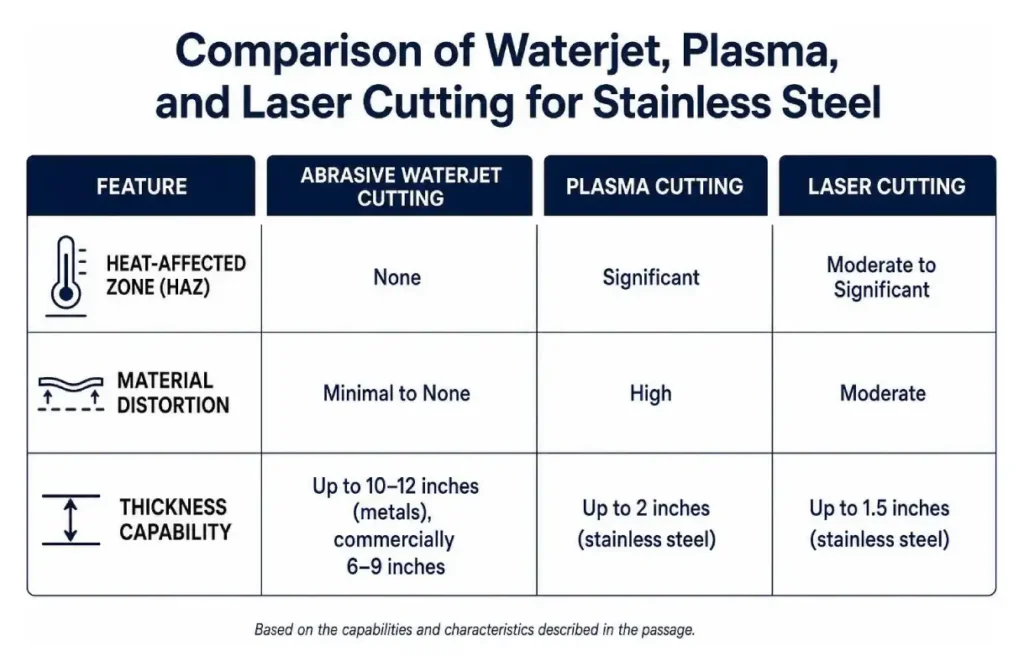
One of the most significant advantages of waterjet cutting, especially for stainless steel and other high-performance alloys, is its nature as a “cold cutting” process. Unlike laser, plasma, or flame cutting, waterjet cutting introduces virtually no heat into the material. This is critical for maintaining the material’s inherent properties.
The absence of a heat-affected zone (HAZ) means there is zero thermal distortion, preventing warping or material property changes that can occur with heat-based cutting methods. For stainless steel, this is particularly important as heat can lead to carbide precipitation, which compromises corrosion resistance.
Waterjet cutting leaves a virgin surface, free from micro-cracking, discoloration, or edge hardening. This often eliminates the need for costly and time-consuming secondary machining or finishing operations, streamlining production and reducing overall costs. The integrity of the material’s microstructure is preserved, ensuring that the final component performs exactly as designed.
To illustrate the distinct advantages, let’s compare waterjet cutting with other common methods for stainless steel:
The capabilities of pressurized water cutting extend far beyond simply making a clean cut. Its inherent precision and efficiency characteristics contribute significantly to material optimization and reduced production costs, making it an indispensable tool in modern stainless steel distribution and fabrication.
Advanced waterjet systems often feature multi-axis cutting capabilities, with 5-axis cutting being a game-changer for complex metal part fabrication. This technology allows the cutting head to tilt and rotate, enabling dynamic kinematic control for intricate geometries, bevel cutting, and weld preparation all in a single operation.
This eliminates the need for multiple setups or secondary machining, dramatically improving efficiency. For industries like aerospace, where complex stainless steel components with precise angles and contours are common, 5-axis waterjet cutting is invaluable. It ensures that parts are fabricated to exact specifications, ready for assembly.
Tight Tolerances and Kerf Optimization
Waterjet cutting is renowned for its ability to achieve exceptionally tight tolerances. Modern machines can attain accuracy down to 0.005 inches (0.13 mm) and repeatability down to 0.001 inches (0.025 mm) under optimal conditions. This level of precision is crucial for components that require exact fitment. The kerf, or the width of the material removed by the cut, is also remarkably narrow, typically ranging from 0.04 to 0.05 inches (1.0–1.3 mm), and can be as fine as 0.02 inches (0.51 mm). This narrow kerf minimizes material waste, a critical factor when working with expensive alloys like stainless steel.
Furthermore, advanced software capabilities allow for automated nesting and common line cutting. Nesting arranges parts on a sheet to maximize material utilization, while common line cutting allows two adjacent parts to share a single cut line, further reducing scrap. The ability to stack multiple sheets of stainless steel and cut them simultaneously also boosts productivity and material efficiency, making it an economical choice for high-volume production.
Supply Chain Precision in Stainless Steel Distribution
The integration of waterjet cutting into the stainless steel supply chain brings a new level of precision and efficiency. By offering custom pre-cutting services, distributors can provide near-net shape parts directly to fabricators. This significantly reduces lead times, as fabricators receive components that require minimal, if any, further processing.
This approach enhances material utilization, as the distributor can optimize cutting patterns across large sheets of stainless steel, minimizing waste before it even reaches the customer. The elimination of secondary finishing operations, thanks to the waterjet’s superior edge quality, further contributes to cost savings and faster turnaround times. Effective inventory management is also supported, as distributors can precisely cut materials to order, reducing the need for customers to maintain large raw material stocks. This symbiotic relationship between precise cutting technology and efficient distribution ultimately benefits the entire manufacturing ecosystem.
Frequently Asked Questions About Stainless Steel Sourcing and Processing
We often encounter questions about the capabilities and advantages of pressurized water cutting for stainless steel. Here, we address some of the most common inquiries to provide further clarity.
What thickness of stainless steel can abrasive waterjets cut?
Abrasive waterjets are exceptionally versatile in cutting various thicknesses of stainless steel. While standard commercial machines typically handle up to 6 inches (150 mm) of stainless steel, advanced systems can cut materials up to 9 inches, and even up to 10-12 inches (250-300 mm) for specialized applications. The maximum thickness achievable depends on several factors, including the water pressure, the type and flow rate of the abrasive, and the desired cutting speed and edge quality. Higher pressure generally allows for faster cutting and greater thickness penetration, as it increases the stream’s power density and kerf coherence, allowing the jet to maintain its cutting energy through thicker material.
Why is cold cutting preferred for corrosion-resistant alloys?
Cold cutting is overwhelmingly preferred for corrosion-resistant alloys like stainless steel precisely because it avoids the heat-affected zone (HAZ) inherent in thermal cutting methods. When stainless steel is exposed to high temperatures, it can undergo metallurgical changes, such as carbide precipitation. This process depletes chromium from the grain boundaries, making the material susceptible to intergranular corrosion and compromising its inherent corrosion resistance. By using a cold cutting process, we ensure that the stainless steel’s passivity is retained, its mechanical integrity remains uncompromised, and there is zero warping or discoloration. This preserves the material’s properties, which is crucial for its performance in demanding environments.
How do distributors ensure zero material distortion during custom cutting?
Ensuring zero material distortion during custom cutting of stainless steel is a hallmark of high-quality processing. This is primarily achieved through the fundamental nature of the waterjet process. Since it’s a cold cutting method, there’s no thermal stress introduced into the material, which is the leading cause of warping and distortion in other cutting techniques.
Additionally, several practices contribute to distortion-free cutting:
- Fixturing Stability: Materials are securely clamped to the cutting bed, providing a stable platform and preventing movement during the cutting process.
- Cold Hydrodynamic Force: The cutting action relies on erosion rather than melting or tearing, applying minimal perpendicular force to the workpiece.
- Low Cutting Pressure (Relative to Material): While the water pressure is ultra-high, the localized force on the material is distributed effectively, preventing deformation.
- Vibration Control: Waterjet machines are designed to minimize vibrations, ensuring a smooth and consistent cut path.
- Submerged Cutting: Often, cutting is performed with the material submerged in water, which further dampens noise, reduces splash, and helps dissipate any minor frictional heat generated, ensuring the material remains cool.
These combined factors allow us to deliver custom-cut stainless steel parts with exceptional dimensional accuracy and no material distortion.
Conclusion
The pursuit of excellence in stainless steel distribution is a continuous journey, one that demands unwavering attention to detail from sourcing to final fabrication. Our commitment to rigorous supplier verification, adherence to stringent processing standards, and the adoption of cutting-edge technologies like pressurized water cutting are central to this mission.
By leveraging the unique advantages of abrasive waterjet technology—its ability to cut without a heat-affected zone, achieve unparalleled precision, and maximize material efficiency—we ensure that every piece of stainless steel maintains its structural integrity and performs optimally. This not only supports advanced fabrication across diverse industries but also contributes to more sustainable distribution practices by minimizing waste and optimizing resource use.
As industries evolve and demand for high-performance materials grows, our dedication to quality assurance and advanced processing capabilities remains steadfast. We believe that by providing the highest quality materials, processed with the utmost precision, we empower our clients to innovate and excel in their respective fields.