Modernizing Your Home with Electrical and Plumbing Upgrades
Our homes are evolving rapidly. From smart devices to electric vehicles and energy-efficient appliances, everything relies on a robust and reliable electrical system. This increasing demand makes your home’s electrical infrastructure more critical than ever in July 2026.
Outdated or undersized electrical and plumbing systems can create hidden problems. They might limit your comfort, lead to higher energy bills, and even pose significant safety risks. Understanding your home’s specific needs is the first step toward a safer, more efficient, and future-ready living space.
In this extensive guide, we will cover everything you need to know about home electrical upgrades. We’ll help you determine your current panel capacity and identify clear warning signs that an upgrade is due. We will also explore the different types of upgrades, from standard 200-amp panels to preparing your home for an EV charger. Finally, we’ll discuss how these electrical changes integrate with your plumbing systems, highlighting the importance of expert advice from certified electrical and plumbing professionals.
Assessing Your System: Signs You Need an Upgrade
An electrical system is like the circulatory system of your home; when it’s not functioning optimally, you’ll start to notice symptoms. Ignoring these warning signs can lead to more than just inconvenience—it can pose significant safety hazards.
One of the most common indicators that your electrical system is struggling is frequent flickering lights, especially when major appliances like your refrigerator or HVAC system kick on. This suggests your system might be overloaded or experiencing voltage drops. Similarly, if you find yourself constantly resetting circuit breakers, it’s a clear signal that circuits are drawing more power than they can safely handle. This isn’t just annoying; it means your system is regularly hitting its safety limits.
Beyond these functional issues, physical signs of deterioration around your electrical panel or outlets are red flags. Look for discolored or scorched outlets, a burning smell, or even a warm or vibrating electrical panel. These could indicate overheating, loose wiring, or other serious problems that demand immediate attention. The average useful lifespan of an electrical panel is between 25 to 40 years.
If your panel is approaching or has exceeded this age, it’s prudent to have it inspected, even if you haven’t noticed obvious problems. Older panels were simply not designed for the electrical demands of a modern household, which often includes multiple computers, large-screen TVs, electric vehicle chargers, and high-efficiency heat pumps.
Identifying Panel Capacity and Outdated Brands
Understanding your current electrical panel’s capacity is fundamental to planning any upgrades. The capacity, measured in amps, dictates how much electricity your home can draw at any given time. To determine your panel’s amperage, locate your main electrical panel, typically found in a basement, garage, or utility closet near your outdoor electric meter.
Open the panel door and look for the main breaker switch, usually a large switch at the top, which will have the amperage rating clearly marked (e.g., 100A, 200A). If the rating is unclear or unlisted, or if you’re uncomfortable opening the panel, a licensed electrician can safely verify it for you. If your panel is less than 60 amps, you are likely already experiencing problems and should strongly consider an upgrade.
It’s also crucial to identify the brand of your electrical panel, as some older brands are notorious for safety issues. Federal Pacific Electric (FPE) Stab-Lok, Zinsco (also sold as Sylvania), and Pushmatic panels are particularly dangerous. Federal Pacific Stab-Lok breakers are known to fail to trip when overloaded, leading to overheating, arcing, and a significant risk of fire.
Zinsco panels have a design flaw where their breakers can weld themselves to the bus bar, preventing them from tripping and potentially causing fires. Pushmatic panels, while not as prone to failure as FPE or Zinsco, often have obsolete parts, making repairs or expansions difficult and costly, and they also pose a fire risk due to age and design. If you have one of these brands, an upgrade isn’t just about convenience or capacity; it’s a critical safety measure to protect your home and family. Many house fires have been traced back to these faulty panels.
The Core Components of Modern Home Electrical Upgrades
Modernizing your home’s electrical infrastructure goes beyond simply replacing a breaker box; it involves a comprehensive assessment of your power needs, potential future demands, and adherence to current safety standards. At its heart, an electrical upgrade is about capacity expansion, ensuring your home can safely and efficiently handle all its electrical loads.
Key to this process are load calculations, which electricians perform to determine your home’s total electrical demand. The National Electrical Code (NEC) provides guidelines for these calculations, specifically NEC 220.82 (Optional Method) and NEC 220.83 (Existing Dwellings). These methods help determine if your existing service can support new appliances or if an upgrade is necessary. Sometimes, for existing dwellings, the NEC 220.83 method, which considers historical demand, can help avoid an unnecessary and costly service upgrade.
Beyond traditional panel upgrades, smart panels are emerging as a cutting-edge solution for load management. These advanced panels, like those from companies such as Lumin or Eaton Pow-R-Command, can dynamically monitor and manage the electrical flow to individual circuits. For instance, a smart panel can automatically cycle off an EV charger when a water heater runs, preventing peak demand from exceeding your home’s service limits.
Intelligent load management can, in some cases, help homeowners avoid an expensive full utility service upgrade, especially when adding high-draw appliances. These devices can cost around $500 and offer a significant saving compared to a multi-thousand dollar service upgrade.
Sizing Your System: When to Choose 200-Amp vs. 400-Amp Home Electrical Upgrades
Choosing the right amperage for your electrical panel is a critical decision that impacts your home’s functionality and future readiness. For most modern homes, a 200-amp service is considered the standard and is typically sufficient to power a fully electrified home, including common high-demand appliances like an electric range, central air conditioning, and even an EV charger and heat pump.
However, there are scenarios where a 400-amp service might be necessary. These typically involve very large homes, properties with multiple high-draw amenities such as a large workshop, an accessory dwelling unit (ADU), a swimming pool with significant equipment, or homes planning for multiple electric vehicles. Before committing to a 400-amp upgrade, have a thorough load calculation performed by a qualified electrician. Unnecessarily upgrading to 400 amps can double the installation cost, adding $2,000–$4,000 to the project, and is rarely justified for a typical single-family home.
The cost of electrical upgrades can vary significantly based on your current setup and the scope of work. Here’s a general overview of typical upgrade costs in July 2026:
Typical Electrical Upgrade Costs (July 2026):
- 100-amp to 200-amp Panel Upgrade: This is the most common upgrade. It typically costs between $1,800 and $3,500, though some regions like San Diego see costs ranging from $2,800 to $4,200. This includes the new panel, main breaker, service entrance conductors, meter base, ground rods, permit fees, and utility coordination.
- 200-amp to 400-amp Service Upgrade: For larger homes or those with exceptionally high electrical demands, this upgrade usually costs between $4,500 and $8,000.
- Same-Amperage Panel Replacement: If your panel is outdated but its amperage is sufficient, replacing it without increasing capacity can cost $1,500 to $2,800.
- Adding a Subpanel: For expanding circuits to a specific area like a garage or ADU, a subpanel costs $500 to $1,500, plus the cost of feeder wire.
- Permit Fees: These typically range from $75 to $400, depending on your local jurisdiction.
These prices reflect the panel itself being a relatively small portion of the cost ($200-$400); the bulk comes from skilled labor, utility coordination, and the inherent risks of working with live electrical components.
Preparing for the Future: EV Chargers and Smart Home Electrical Upgrades
The rise of electric vehicles (EVs) and smart home technology is a major driver for electrical upgrades. Installing an EV charger, particularly a Level 2 charger, requires significant electrical capacity. Level 2 chargers use a 240V circuit and can add 10-30 miles of range per hour, far faster than a standard 120V Level 1 charger. Many Level 2 chargers connect to a NEMA 14-50 outlet, similar to those used for electric dryers, or are hardwired directly.
Before installing an EV charger, assess your electrical panel’s capacity and available breaker slots. A 200A panel can typically handle an EV charger and a heat pump in most homes with standard loads, but a load calculation is always recommended. If your panel is 100A or less and has few or no empty slots, an upgrade will likely be necessary.
To make these upgrades more affordable, several incentives are available. The federal government offers a tax credit of 30% of the project cost, up to $600, for improving or replacing electrical panels to enable the installation of qualified energy efficiency improvements or energy property.
For EV charger and associated wiring installation, federal incentives cover 30% of the installed cost, up to $1,000. These incentives, largely part of the Inflation Reduction Act, are available through December 31, 2025 (for panel upgrades) and beyond (for EV chargers). Additionally, many local utility providers offer rebates for EV charger installations and other energy-efficient upgrades, so it’s always worth checking their websites or the ENERGY STAR Rebate Finder for local programs.
Beyond EVs, smart home integration, including smart thermostats, lighting systems, and energy monitoring devices, also benefits from a robust electrical system. While individual smart devices draw minimal power, a fully integrated smart home relies on a stable and sufficient power supply.
Integrating Electrical and Plumbing Systems Safely
In modern homes, electrical and plumbing systems are increasingly intertwined, particularly with the adoption of electric appliances like heat pumps for heating and cooling, and heat pump water heaters. These highly efficient systems rely on electricity to operate, and their installation often necessitates a review or upgrade of your electrical panel.
For instance, a whole-home cold-climate heat pump with electric backup can pull 60A to 80A, while a heat pump water heater might require a dedicated 30A or 50A circuit. These loads can quickly push an older 100A or even a fully loaded 200A panel beyond its capacity. Proper system coordination is vital to ensure that your electrical infrastructure can safely support these new, energy-efficient plumbing appliances. This often involves ensuring adequate wiring, dedicated circuits, and sufficient panel capacity.
Safety grounding is another critical aspect where electrical and plumbing systems intersect. All major electrical appliances, including those connected to your plumbing (like water heaters and well pumps), must be properly grounded to prevent electrical shock hazards. This is a fundamental safety requirement of the National Electrical Code (NEC).
Given the complexity and the critical safety implications, it’s paramount to rely on professional installation for these integrated systems. Attempting DIY electrical or plumbing work can lead to dangerous situations, code violations, and potentially void your home insurance.
When considering upgrades that involve both electrical and plumbing, seeking advice from a company offering comprehensive services, such as certified electrical and plumbing professionals, ensures that all aspects are handled correctly and safely. These professionals will also navigate the permit requirements, which are mandatory for most significant electrical and plumbing upgrades to ensure compliance with local building codes and safety standards.
Frequently Asked Questions About Electrical Upgrades
Homeowners often have many questions when considering electrical upgrades, and rightly so. These projects represent a significant investment in your home’s safety and future. Here, we address some of the most common inquiries to provide clarity and expert advice.
What are the most common mistakes homeowners make when planning an electrical upgrade?
One of the most significant mistakes homeowners make is attempting unpermitted work or DIY electrical projects. Electrical work is highly specialized and dangerous, and most jurisdictions require permits and inspections to ensure safety and code compliance. Unpermitted work can lead to fines, difficulties with home insurance claims (as any related fire claim could be denied), and severely impact resale value. The utility company will almost never pull the meter for an unlicensed homeowner, making service work impossible without a professional.
Another common error is making incorrect load calculations or failing to have one done at all. Homeowners might assume their panel needs a 400-amp upgrade when a 200-amp panel, combined with smart load management, would be perfectly sufficient. A licensed electrician will perform a proper load calculation (per NEC Article 220) to determine actual needs, preventing unnecessary expenses.
Finally, ignoring future needs is a mistake that can lead to repeat upgrades. When planning, consider not just your immediate needs (like a new heat pump) but also potential future additions, such as a second EV, a hot tub, or a finished basement. Planning for these now can save considerable time and money down the line. It’s also a mistake to get fewer than three quotes or to accept a quote that omits permit fees, as this often indicates a contractor planning to bypass proper procedures.
How long does a typical panel upgrade take, and will my power be turned off?
The physical installation of a panel upgrade is surprisingly quick, typically taking 4 to 8 hours of power-off time across your entire house. During this period, the utility company will temporarily disconnect power to your home, allowing the electrician to safely remove the old panel, install the new one, reconnect circuits, and perform necessary grounding updates. It’s crucial to coordinate with your electrician if you have medical equipment or critical home office needs, as they might be able to arrange for a portable generator during the outage.
However, the entire project timeline, from initial consultation to final inspection, usually spans one to three weeks. This duration accounts for obtaining permits from your local municipality, coordinating with the utility company for the disconnect and reconnect, and scheduling the final inspection by a city or county electrical inspector. City turnaround times for permits and utility scheduling can vary, so patience is key. It’s also a best practice to clearly label all branch circuits before the day of the panel swap to help the electrician and save labor time.
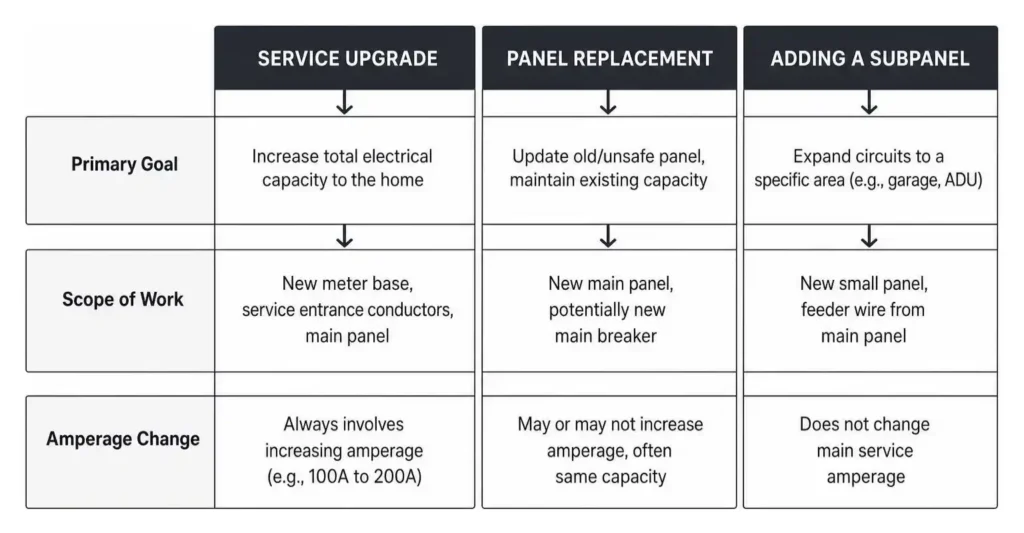
What is the difference between a service upgrade, a panel replacement, and adding a subpanel?
These terms are often used interchangeably, but they refer to distinct types of electrical work with different scopes and implications. Understanding the differences is crucial for effective planning.
Panel Replacement
This involves replacing your existing main electrical panel (the breaker box) with a new one. It might be done to replace an outdated, unsafe brand (like Federal Pacific or Zinsco), to add more breaker slots, or to update an old panel that is simply at the end of its useful life (25-40 years). While a panel replacement can be part of a service upgrade, it can also be done without increasing the total incoming amperage from the utility.
Adding a Subpanel
A subpanel is a smaller, secondary electrical panel that draws power from your main panel. It’s used to distribute circuits to a specific area of your home, like a garage, workshop, or an addition, without needing to run individual wires all the way back to the main panel. Adding a subpanel expands your home’s internal circuit capacity in a localized area but does not increase the overall amperage coming into your home from the utility.
Conclusion
Modernizing your home’s electrical and plumbing systems is a foundational step toward a safer, more efficient, and future-ready living space. In July 2026, with the increasing reliance on electricity for everything from daily comfort to sustainable transportation, ensuring your home’s infrastructure can meet these demands is more important than ever.
By understanding the signs of an outdated system, identifying dangerous panel brands, and planning for future needs like EV chargers and heat pumps, you can proactively enhance your home’s functionality and safety. While the process of electrical upgrades might seem daunting, the benefits—including improved safety, lower energy bills, enhanced property value, and the ability to embrace new technologies—are substantial.
Electrical work is not a DIY endeavor. Always consult with qualified professionals who can assess your specific needs, perform accurate load calculations, and ensure all work adheres to the latest safety codes and regulations. Investing in professional consultation and installation is an investment in your home’s long-term health and your family’s peace of mind.