Maintaining Your Home Heating and Cooling Systems
Making informed decisions about your home’s major systems, particularly heating and cooling, requires a structured approach. It’s not merely about the immediate repair cost but a comprehensive financial evaluation and strategic asset management. We delve into established decision models that can guide homeowners and facility managers alike.
Financial Rules of Thumb for Home Heating and Cooling Repairs
Several widely recognized financial rules of thumb can help clarify the repair versus replacement dilemma. While some originated in military logistics or industrial maintenance, their core principles are highly applicable to residential heating and cooling systems.
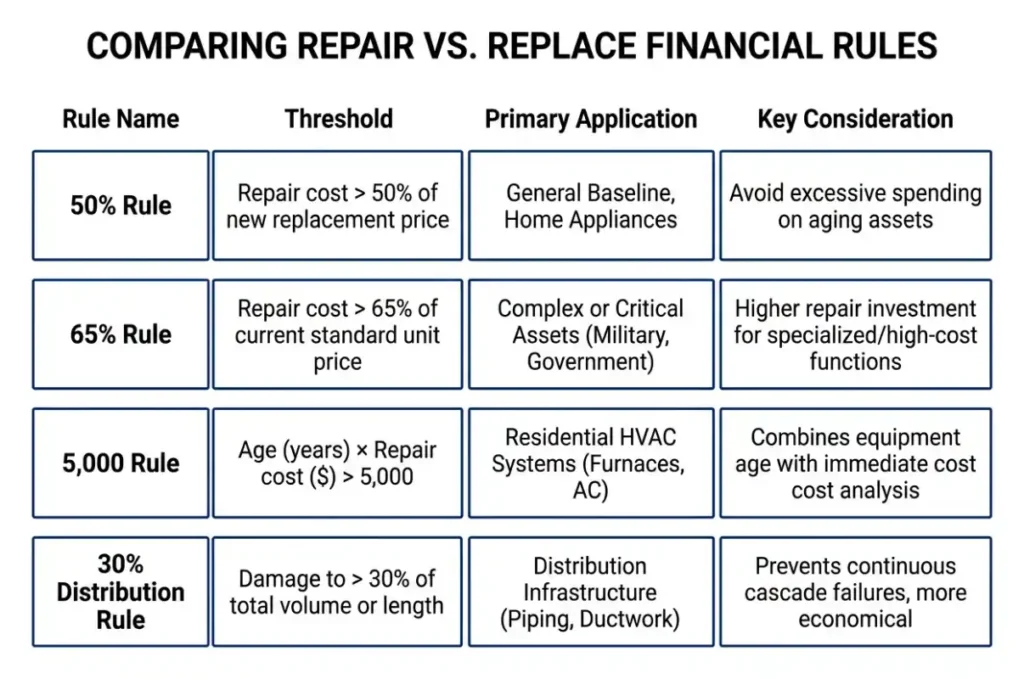
The 50% Rule is perhaps the most common: if a repair is estimated to cost 50% or more of the price of a brand-new replacement unit, then replacement is generally the more sensible option. This rule serves as a straightforward baseline, encouraging homeowners to consider the long-term value rather than just the immediate fix. However, as we’ll see, its application can be refined by other factors.
For more complex or critical assets, a slightly more lenient 65% Rule is sometimes adopted, drawing inspiration from military and governmental standards. For instance, the US Marine Corps considers a repair economical if it costs less than 65% of the current standard unit price. Similarly, the US Army applies a 65% threshold for computer assets, beyond which repair or upgrade is not authorized. This higher threshold acknowledges that some assets, particularly those with high initial costs or specialized functions, might justify a larger repair investment.
A particularly useful rule for residential HVAC systems is the 5,000 Rule. This calculation takes both age and repair cost into account. The formula is simple: multiply the equipment’s age in years by the estimated repair cost in dollars. If the product exceeds $5,000, replacement is often the smarter financial move. For example, a 10-year-old furnace needing a $600 repair yields a product of $6,000 (10 x $600), suggesting replacement. Conversely, a 5-year-old system with a $400 repair yields $2,000 (5 x $400), making repair a viable option. This rule effectively adds an age-adjusted dimension to the cost analysis.
Finally, for distribution infrastructure like piping and ductwork, the 30% Distribution Rule comes into play. If leaks, damage, or degradation affect more than 30% of the total volume or length of these systems, patching individual sections becomes cost-ineffective. A full replacement is often more economical in the long run, preventing continuous cascade failures in remaining aged sections.
Here’s a quick comparison of these key financial rules:
The Cumulative Cost Trap and Repair Frequency
While individual repair costs are important, it’s crucial to look beyond a single incident. Many homeowners fall into the “nickel-and-dime trap,” where a series of smaller, seemingly manageable repairs accumulate over time, ultimately exceeding the cost of a new system without providing the benefits of modern efficiency or a new warranty.
A pattern of repeated failures or a high frequency of repair is a strong indicator that replacement is warranted. If your HVAC system, for instance, requires its third major repair within a 24-month period, it’s likely approaching the end of its reliable service life. These frequent breakdowns not only cause inconvenience but also suggest underlying systemic issues, often leading to cascade failures where one failing component stresses others, causing a domino effect of breakdowns.
To avoid this trap, maintain detailed service logs for all major home systems. Tracking the dates, costs, and nature of each repair provides a clear history that can highlight a trend of escalating issues. When comparing a repair quote, consider the total cumulative repair costs against the price of a new unit.
It’s also important to understand the role of diagnostic fees. These fees, typically ranging from $75 to $125, are paid to a technician to identify the problem. Many experts advise treating diagnostic fees as a sunk cost, meaning they should not influence the decision to proceed with a repair or replacement. The decision should be based solely on the repair quote itself compared to the replacement cost, preventing you from approving an ill-advised repair just to “get your money’s worth” from the diagnostic visit.
Evaluating Age, Efficiency, and Total Cost of Ownership
Beyond immediate repair costs, the age of your equipment, its energy efficiency, and the total cost of ownership (TCO) over its remaining lifespan are critical factors. An older system might appear functional, but its internal components could be degrading, and its operational costs could be significantly higher than a modern equivalent.
Age Thresholds and Lifespan Percentages
Every major home system has an expected lifespan. Understanding where your unit falls within this lifespan is fundamental to the repair vs. replacement decision.
- Warranty Coverage (0-5 years): For newer systems still under manufacturer warranty, repairs are almost always the preferred option, assuming the issue isn’t due to neglect or improper use. This is the period of lowest risk and highest reliability.
- Mid-Life Evaluation (6-10 years): As systems enter their mid-life, the decision becomes more nuanced. Minor repairs are typically still worthwhile, but major component failures (like a compressor in an AC unit or a heat exchanger in a furnace) warrant a closer look at replacement.
- Terminal Lifespan (11+ years): Once a system approaches or exceeds its expected lifespan (e.g., 10-15 years for an HVAC system, 8-12 years for a water heater), replacement becomes increasingly favorable. Even if a repair is technically possible, the unit may soon face other failures, and its efficiency will likely be significantly lower than modern alternatives.
Some decision frameworks introduce an age-adjusted cost threshold. For equipment that has passed 75% of its expected lifespan, the acceptable repair cost threshold drops significantly, sometimes to as low as 30% of the replacement cost. This acknowledges that investing in an aging asset provides diminishing returns and that its remaining operational life is likely short.
Balancing Efficiency Gains in Home Heating and Cooling Equipment
One of the most compelling arguments for replacement, especially for older systems, is the potential for substantial energy savings. Modern heating and cooling technologies have made significant strides in efficiency.
For air conditioners and heat pumps, new SEER2 ratings (Seasonal Energy Efficiency Ratio 2) reflect more accurate testing conditions and higher minimum efficiency standards that came into effect in January 2023. Replacing a 15-year-old 10 SEER air conditioner with a modern 16 SEER2 unit, for example, can reduce cooling energy consumption by approximately 37%. Similarly, upgrading an older furnace operating at 78% AFUE (Annual Fuel Utilization Efficiency) to a high-efficiency condensing furnace (96%+ AFUE) can lead to considerable reductions in heating costs.
Heat pump technology, in particular, offers impressive efficiency. Replacing a standard electric resistance water heater (0.9 UEF – Uniform Energy Factor) with a heat pump water heater (3.5+ UEF) can reduce water heating energy by approximately 70%, potentially saving hundreds of dollars annually. A 15-year-old refrigerator can also consume 2 to 3 times more energy annually than a current Energy Star model.
Calculating the total cost of ownership (TCO) involves factoring in not only the initial repair or replacement cost but also projected energy savings, estimated future repair costs, and the lifespan of the new equipment. Over a 5-to-10-year horizon, a new, more efficient system often proves to be the more economical choice, even with a higher upfront investment. When considering any service, ensuring high-quality workmanship is paramount, as it directly impacts the longevity and efficiency of your system.
Safety Risks and Regulatory Factors That Override Financial Formulas
While financial calculations are crucial, certain situations immediately override all cost-benefit analyses. Safety should always be the top priority, and some hazards demand immediate replacement regardless of the unit’s age or repair cost.
Critical Safety Hazards and Emergency Triggers
Any system posing an immediate threat to life or property must be addressed without delay. These zero-tolerance hazards include:
- Carbon Monoxide (CO) Leaks: A colorless, odorless, and highly toxic gas, CO leaks from heating systems are extremely dangerous. A cracked heat exchanger in a furnace is a primary cause of CO leaks and necessitates immediate system replacement. No repair can reliably fix this critical flaw.
- Gas Leaks: Any detection of a natural gas or propane leak from a furnace or water heater requires immediate attention and often leads to replacement if the leak is systemic or from a critical, unrepairable component.
- Electrical Risks: Frayed wiring, frequent circuit breaker trips, or visible scorching around electrical components can indicate severe electrical faults that pose a significant fire hazard.
- Structural Failure: Physical damage that compromises the structural integrity of a unit, particularly if it’s load-bearing or contains dangerous elements, also triggers immediate replacement.
In such scenarios, the decision is not financial but ethical and safety-driven. Professional technicians are trained to identify these dangers and will advise immediate system shutdown and replacement.
Regulatory Changes and Environmental Incentives
External factors, such as government regulations and environmental policies, can also significantly influence the repair vs. replacement decision.
One notable example is the R-22 refrigerant phaseout. As of January 2020, the manufacturing and import of R-22 (commonly known as Freon) were banned in the United States. This has made R-22 increasingly scarce and expensive. For older air conditioning units that use R-22, any repair involving a refrigerant leak or recharge becomes prohibitively costly, often pushing the decision decisively towards replacement with a newer, R-410A or R-32 based system.
Parts availability is another practical concern. Manufacturers typically discontinue model lines 10 to 15 years after production, leading to a “parts availability cliff.” Finding replacement parts for very old systems can be difficult, expensive, or even impossible, making replacement the only viable option.
On the incentive side, programs like the Inflation Reduction Act (IRA), enacted in August 2022, offer substantial financial benefits for homeowners upgrading to energy-efficient systems. The IRA’s Section 25C tax credits provide up to $2,000 for qualifying heat pump HVAC systems and heat pump water heaters, effectively lowering the cost of replacement and making it a more attractive option than repairing an inefficient older unit. Additionally, many local utilities offer rebates for upgrading to high-efficiency equipment. These incentives can significantly offset the upfront cost of a new system, making replacement a more financially appealing choice.
Here are some key non-financial factors to consider:
- Technological Obsolescence: Does your current system lack features or capabilities that are now standard and beneficial (e.g., smart thermostat integration, variable-speed operation)?
- Regulatory Changes: Is your system using phased-out refrigerants or failing to meet current efficiency standards?
- Parts Availability: Are replacement parts for your older model becoming scarce or expensive?
- Comfort and Noise: Is the old system providing inconsistent comfort or operating excessively loudly?
- Environmental Impact: Does a new, more efficient system align better with your environmental values?
- Home Value: Will upgrading a major system increase your home’s market value or appeal to future buyers?
Frequently Asked Questions About Home Systems
We understand that the repair vs. replacement decision can be complex. Here are answers to some common questions homeowners ask:
What is the 5,000 rule for HVAC equipment?
The 5,000 Rule is a practical guideline to help homeowners decide between repairing and replacing their HVAC systems. It states that if the product of the equipment’s age (in years) and the estimated repair cost (in dollars) exceeds $5,000, replacement is generally the more financially prudent choice. For example, if your air conditioner is 12 years old and needs a $500 repair, the calculation is 12 years * $500 = $6,000. Since $6,000 is greater than $5,000, the rule suggests replacement. This rule helps factor in the diminishing return on investment for repairs on older units.
When does a safety hazard force immediate system replacement?
Immediate system replacement, regardless of financial calculations, is required when a system poses a direct and unmitigable safety hazard. This includes:
- Carbon Monoxide (CO) Risk: A cracked heat exchanger in a furnace, which can leak CO into your home, is a critical safety hazard.
- Gas Leaks: Any uncontrolled gas leak from a furnace, water heater, or other gas appliance.
- Severe Electrical Faults: Exposed wiring, persistent sparking, or components at risk of causing an electrical fire. These conditions are non-negotiable and demand immediate action to protect occupants.
How do IRA tax credits impact the replacement decision?
The Inflation Reduction Act (IRA), as of August 2026, significantly impacts the replacement decision by offering generous tax credits for energy-efficient home improvements. Specifically, Section 25C provides homeowners with a tax credit of up to $2,000 for installing qualifying heat pump HVAC systems and heat pump water heaters. These incentives reduce the effective upfront cost of new, highly efficient equipment, making replacement a much more financially attractive option compared to continually repairing an older, less efficient system. Homeowners can save money on both the installation and their long-term energy bills.
Conclusion
Deciding whether to repair or replace a major home system like your furnace or air conditioner is a multifaceted decision that blends financial prudence, safety considerations, and long-term comfort. By applying established rules of thumb like the 50% Rule and the 5,000 Rule, tracking cumulative repair costs, and carefully evaluating age and efficiency, you can move beyond a gut feeling to make an informed choice.
Always prioritize safety, as hazards like carbon monoxide or electrical risks demand immediate replacement. Furthermore, consider how modern energy efficiency gains and current incentives, such as those from the Inflation Reduction Act, can make replacement a financially superior option in the long run.
Proactive planning, maintaining service records, and consulting with trusted professionals are your best allies in navigating these decisions. The goal is to ensure your home remains a safe, comfortable, and efficient sanctuary for years to come, securing both your immediate peace of mind and your long-term investment.