A Guide to Securing VA Home Loans for Veterans
For many veterans and active service members, securing a home is a significant achievement. In 2026, if you are considering a higher-value property, understanding 30 year fixed VA jumbo mortgage rates is crucial. These loans offer unique advantages, often allowing for no down payment, even on substantial loan amounts.
However, the term “jumbo” in VA lending can be confusing. It does not always mean a strict loan limit from the VA itself. This guide will clarify how these loans actually work.
We will explore eligibility criteria and how your VA entitlement affects down payment requirements. We will also compare VA jumbo rates to conventional options. Finally, we will provide tips on securing the most competitive rates from lenders, including those who specialize as a direct VA mortgage lender. Our goal is to empower you to navigate the VA jumbo loan process with confidence.
Core Benefits and Structures of VA Home Loans
VA home loans stand out as a superior financing option for eligible service members, veterans, and surviving spouses. These loans are not directly issued by the Department of Veterans Affairs but are provided by private lenders (banks, credit unions, and mortgage companies) and partially guaranteed by the VA. This federal guarantee significantly reduces the risk for lenders, allowing them to offer more favorable terms than conventional mortgages.
The core benefits of VA loans are substantial and contribute to their popularity among the military community. Firstly, the most celebrated advantage is the 0% down payment option. Unlike most other loan programs that require a significant upfront investment, VA loans often allow qualified borrowers to finance 100% of their home purchase price, even for high-value properties. This eliminates a major barrier to homeownership for many.
Secondly, VA loans do not require Private Mortgage Insurance (PMI). Conventional loans typically mandate PMI when a borrower puts down less than 20% of the home’s purchase price, adding an extra monthly cost. The absence of PMI on VA loans translates into considerable savings over the life of the mortgage, further lowering the overall cost of homeownership.
Another unique feature is loan assumability. This means that in certain circumstances, a qualified buyer—even a non-veteran—can take over an existing VA loan’s terms, including its interest rate. In a rising interest rate environment, this can make a home with an assumable VA loan particularly attractive to potential buyers, enhancing its resale value.
Finally, VA loans generally offer competitive pricing and often come with lower interest rates compared to conventional loans. The federal backing minimizes lender risk, which is typically passed on to the borrower in the form of more attractive rates. This combination of no down payment, no PMI, and lower rates makes VA financing an exceptionally cost-effective solution for eligible individuals.
How VA Home Loans Compare to Conventional Mortgages
When evaluating mortgage options, understand the distinct differences between VA financing and conventional loans. These differences can significantly impact a borrower’s financial outlay and long-term costs.
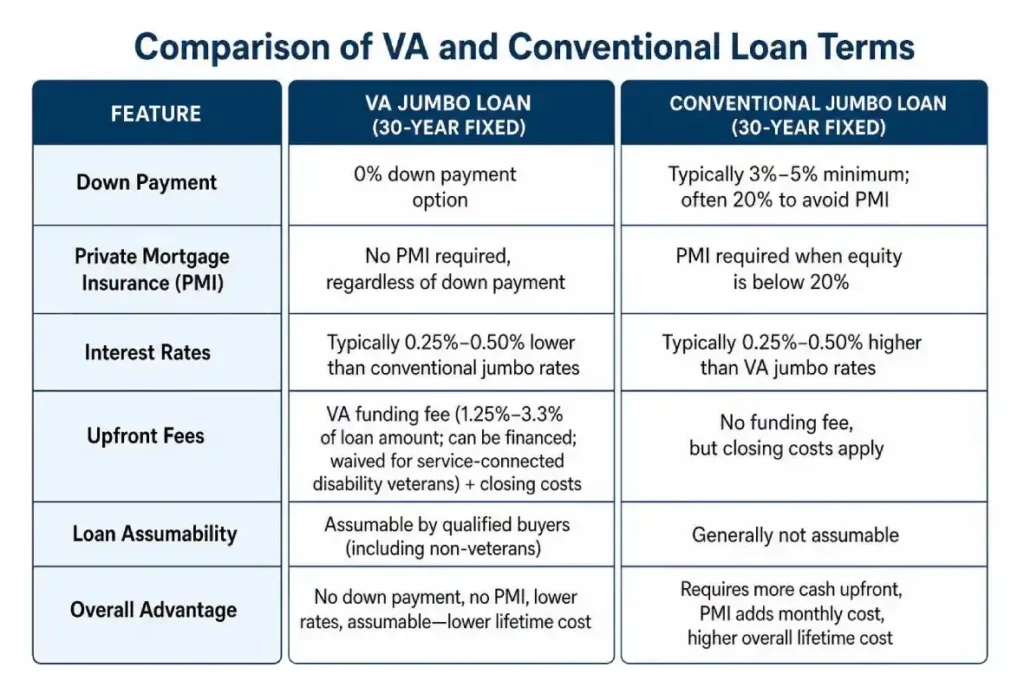
The most striking contrast lies in the down payment requirements. While VA loans famously allow for 0% down, conventional loans typically require a minimum of 3% to 5% down, and often 20% to avoid PMI. For a $500,000 home, a 3% conventional down payment would be $15,000, an amount a VA borrower could keep in savings.
Related to this, monthly PMI is a standard feature of conventional loans when the equity is below 20%. This insurance protects the lender, not the borrower, and can add hundreds of dollars to a monthly payment. VA loans, regardless of the down payment amount, never require PMI, leading to substantial savings over the loan term.
In terms of interest spread, VA jumbo rates are typically 0.25% to 0.50% lower than conventional jumbo rates, especially when working with lenders specializing in VA products. This rate advantage, combined with the absence of PMI, contributes to a lower overall lifetime cost for VA borrowers.
Upfront, both loan types have closing costs, but VA loans also include a VA funding fee. This fee, which ranges from 1.25% to 3.3% of the loan amount, helps offset the cost to taxpayers. However, it can often be financed into the loan, and critically, it is waived for veterans with service-connected disabilities. Conventional loans do not have a funding fee, but their closing costs can still be substantial.
To illustrate these differences, consider the following comparison:
Fixed-Rate Options for VA Home Loans
Within the VA loan program, borrowers have access to various fixed-rate options, with the 30-year fixed mortgage being the most common and often preferred choice. This option provides unparalleled payment stability, as the interest rate and the principal and interest portion of the monthly payment remain constant for the entire three-decade term. This predictability allows homeowners to budget effectively without concerns about fluctuating payments due to market changes.
Another popular choice is the 15-year fixed VA loan. While it typically comes with a slightly lower interest rate than its 30-year counterpart, the monthly payments are considerably higher because the loan amount is repaid over half the time. This option is ideal for borrowers who can comfortably afford the higher payments and wish to build equity faster and pay significantly less interest over the life of the loan.
The stability of a fixed note rate is a major draw. Unlike adjustable-rate mortgages (ARMs), which have rates that can change after an initial fixed period, a fixed-rate loan ensures that your primary housing expense remains constant. When comparing offers, it’s crucial to look beyond just the note rate and consider the Annual Percentage Rate (APR), which includes certain fees and closing costs, providing a more accurate picture of the loan’s true cost.
The amortization schedule of a fixed-rate loan dictates how your payments are applied over time, with more interest paid in the early years and more principal in the later years. Understanding this schedule can help borrowers plan for potential extra principal payments to accelerate equity growth.
Mortgage rates, including VA rates, are often influenced by broader economic factors, particularly the 10-year Treasury yield. While VA rates consistently track lower than conventional rates, they are not immune to market movements. Locking in a rate at an opportune time can protect borrowers from upward rate volatility during the loan processing period.
Eligibility Standards and Certificate of Eligibility
To access the benefits of a VA home loan, the first and most critical step is to establish eligibility and obtain a Certificate of Eligibility (COE). The COE is an official document from the VA that confirms to lenders that you meet the service requirements for a VA loan. It outlines your entitlement, which is the amount the VA will guarantee on your loan.
The process of obtaining a COE is relatively straightforward. Most lenders can help you retrieve it electronically through the VA’s online system. Alternatively, you can apply for it directly through the VA’s eBenefits portal or by mail using VA Form 26-1880, “Request for Certificate of Eligibility.”
You will typically need to provide documentation of your service, such as your DD-214 (Certificate of Release or Discharge from Active Duty), or other service statements for active duty personnel, National Guard, Reserve members, or surviving spouses. Understanding your COE is fundamental, as it details your specific entitlement codes and any prior usage that might affect your current loan options.
Qualifying Service Requirements
The VA loan program is designed to assist those who have served our nation. Eligibility is determined by specific service requirements, ensuring the benefits reach those who have earned them.
For active duty personnel, generally, 90 consecutive days of active service during wartime or 181 days during peacetime are required. For members of the National Guard and Reserves, the requirement is typically six years of honorable service, or 90 days of active duty under Title 10 orders.
An honorable discharge is a universal prerequisite for all service members. The VA scrutinizes service records to confirm that the applicant’s discharge status meets the program’s criteria.
Surviving spouses may also be eligible for VA loan benefits if their spouse died while in service or from a service-connected disability, and they have not remarried (or remarried after a certain age). The VA assesses each case individually to determine eligibility based on the specific circumstances of the veteran’s death and the spouse’s marital status.
Understanding Full vs. Partial Entitlement
The concept of VA entitlement is crucial, especially when considering higher loan amounts. Your entitlement is the amount the VA guarantees to the lender. It comes in two main forms: basic and bonus (or second-tier) entitlement.
Basic entitlement is generally $36,000. For loans over $144,000, the VA provides bonus entitlement, which effectively guarantees 25% of the FHFA conforming loan limit for the county where the property is located. This 25% guaranty is key to understanding how much you can borrow without a down payment.
Full entitlement means you have never used your VA loan benefit, or you have used it and fully restored it (e.g., by selling the home and paying off the loan, or by having another eligible veteran assume your loan). With full entitlement, the VA effectively has no loan limit for the borrower, meaning you can typically purchase a home with $0 down, regardless of the loan amount (as long as the lender approves).
Partial entitlement occurs when you have used your VA loan benefit in the past, and that entitlement has not been fully restored. This often happens if you still own a home financed with a VA loan or if you sold a home but did not pay off the VA loan in full (e.g., through a short sale or foreclosure).
When you have a prior guaranty charged against your entitlement, your remaining entitlement is reduced. This reduction can impact your ability to get another VA loan with $0 down, especially for loans exceeding the conforming limits. The VA calculates your remaining entitlement, and your zero-down borrowing capacity is typically four times that remaining amount. If your desired loan exceeds this figure, a down payment will be required. The restoration process for entitlement is possible, usually by selling the property and paying off the VA loan, or in some cases, by refinancing out of the VA loan.
High-Balance Financing and Jumbo Lending Guidelines
The term “VA jumbo loan” can often be a source of confusion. It’s important to clarify that the VA itself does not officially recognize or impose a “jumbo” loan limit for borrowers with full entitlement. The concept of a “jumbo” loan is largely a lender’s designation for a VA-backed loan that exceeds the conforming limits set by the Federal Housing Finance Agency (FHFA) for conventional loans.
For 2026, the standard conforming loan limit is $832,750 in most U.S. counties. In designated high-cost counties, these limits can extend significantly higher, reaching up to $1,249,125 and even $1,299,500 in the most expensive areas. These FHFA limits are critical for lenders, as they determine the size of loan they can sell to Fannie Mae and Freddie Mac.
The ability for veterans with full entitlement to secure loans above these conventional conforming limits with $0 down largely stems from the Blue Water Navy Vietnam Veterans Act of 2019. This legislation eliminated the statutory VA loan limits for borrowers with full entitlement, effectively allowing them to finance 100% of the purchase price on any loan amount, provided the lender approves.
Zero-Down Rules for High-Value Properties
One of the most compelling aspects of VA financing for high-value homes is the potential for a zero-down payment, even on loans exceeding $1,000,000. This is possible for borrowers with full entitlement. The VA’s guarantee effectively provides unlimited backing for these loans, assuming the veteran has full entitlement and meets the lender’s underwriting criteria. This means that a veteran with full entitlement can purchase a $1,000,000 home with $0 down in any of the 3,235 FHFA county rows in 2026, even if the local conforming limit is below that amount.
However, the situation changes for borrowers with partial entitlement. If you have a prior VA loan that has not been fully paid off or your entitlement has not been restored, you may be required to make a down payment on a high-value property. The down payment threshold in these scenarios is calculated based on your remaining entitlement.
Here’s how the partial entitlement formula generally works: The VA will guarantee 25% of the FHFA conforming loan limit for your county, minus any entitlement you’ve already used (your prior guaranty). Your maximum zero-down loan amount is then four times this remaining entitlement. Any loan amount above that figure will require a down payment of 25% of the difference.
For example, if you have a $208,188 prior VA guaranty charged (which is 25% of the $832,750 baseline conforming limit) and you’re looking to purchase a $1,000,000 home in a baseline county, your remaining zero-down capacity would be $0. This would necessitate a $250,000 down payment (25% of the $1,000,000 loan amount) because you’ve essentially used up your full entitlement for a loan of that size in a baseline county. In contrast, if you were buying the same $1,000,000 home in a high-cost county with a $1,249,125 limit and the same prior guaranty, you would have some remaining entitlement, requiring a smaller down payment.
While the VA offers incredible flexibility, particularly for borrowers with full entitlement, it’s crucial to understand that individual lenders often impose their own additional requirements, known as lender overlays. These overlays are designed to mitigate the lender’s risk, especially on larger loan amounts that exceed conventional conforming limits.
For VA jumbo loans, common lender overlays include stricter cash reserves requirements. Lenders may ask for several months (e.g., 6 to 12 months) of mortgage payments in liquid assets after closing to ensure the borrower can handle potential financial disruptions. This is particularly true for loans significantly above the conforming limits.
Lenders also typically maintain their own underwriting standards that might be more stringent than the VA’s minimums. This can include higher minimum credit score requirements (beyond the VA’s informal 620 benchmark) or lower debt-to-income (DTI) caps. While the VA has flexible DTI guidelines, lenders might cap it at a lower percentage for jumbo loans to ensure repayment ability.
Asset verification becomes even more critical for high-balance loans. Lenders will thoroughly review bank statements, investment accounts, and other liquid assets to confirm that the borrower has the necessary reserves and sufficient funds for closing costs (if not financed). Borrowers should be prepared to provide detailed documentation of their financial standing to meet these enhanced criteria.
Interest Rates, Fees, and Underwriting Standards
Understanding the financial mechanics of VA jumbo loans involves more than just the principal amount. It requires a close look at interest rates, associated fees, and the specific underwriting standards that lenders apply. As of August 2026, current 30-year fixed VA jumbo mortgage rates typically range from 5.50% to 6.00% interest, with APRs ranging from 6.09% to 6.34%. The national average 30-year VA mortgage interest rate is 6.35%, slightly down from the previous week.
When comparing loan offers, focus on the APR (Annual Percentage Rate) rather than just the nominal note rate. The APR provides a more comprehensive measure of the loan’s cost, as it incorporates the interest rate along with certain fees and charges. This allows for a truer side-by-side comparison between different lenders.
Borrowers also have the option to pay discount points. One discount point typically costs 1% of the loan amount and can reduce the interest rate by approximately 0.25%. Deciding whether to pay points depends on how long you plan to stay in the home; if you anticipate keeping the mortgage for many years, paying points upfront can lead to significant long-term savings.
Once you find a favorable rate, a rate lock is crucial. This agreement with the lender freezes your interest rate for a specified period (e.g., 30-60 days), protecting you from market fluctuations while your loan is being processed. In a volatile market, timing your rate lock can be a strategic decision.
Mortgage rates are closely tied to broader economic indicators, particularly the 10-year Treasury bond yield. When the yield rises, mortgage rates tend to follow suit, and vice versa. Staying informed about these market trends can help you identify opportune times to secure your loan.
Credit Scores and Residual Income
To qualify for the most competitive VA jumbo rates, your financial profile must be strong. While the VA does not set a minimum credit score, most lenders require a minimum credit score of 680 for VA loans, with scores of 740+ qualifying for the best advertised rates. A lower credit score can significantly impact your interest rate; a 40-point difference in credit score can cost you an additional $50-$100+ per month on a $500,000 VA jumbo loan. Improving your credit score before applying can yield substantial savings over the life of the loan.
Beyond credit score, the VA emphasizes residual income. This unique underwriting requirement assesses the amount of disposable income a veteran has left each month after all major monthly expenses (debts, taxes, insurance, and housing costs) are paid. The VA sets specific residual income thresholds that vary by region and family size, ensuring that borrowers have sufficient funds for day-to-day living expenses.
Lenders also evaluate your debt-to-income (DTI) ratio, which compares your total monthly debt payments to your gross monthly income. While the VA has flexible DTI guidelines, lenders often impose stricter DTI limits for jumbo loans as part of their overlays.
Here is a list of mandatory VA underwriting requirements that lenders consider:
- Sufficient residual income: Ensuring enough disposable income for living expenses.
- Acceptable DTI ratio: Balancing monthly debt payments against income.
- Stable employment history: Demonstrating consistent income.
- Satisfactory credit history: A track record of responsible borrowing.
- Property appraisal meeting VA standards: Ensuring the home’s value and condition are acceptable.
- Valid Certificate of Eligibility (COE): Proof of VA loan entitlement.
Funding Fee Tiers and Disability Waivers
A key component of VA loan costs is the VA funding fee. This one-time fee is paid directly to the VA and helps defray the program’s costs for U.S. taxpayers. The amount of the funding fee is a percentage of the loan amount and varies based on several factors:
- First-time use vs. subsequent use: The fee is typically lower for first-time VA loan users.
- Down payment amount: A larger down payment can reduce the funding fee percentage.
- Service category: Regular military, Reserves, and National Guard can have slightly different rates.
For instance, a first-time user with 0% down might pay a funding fee of 2.15%, while a subsequent user with 0% down might pay 3.3%. If a down payment of 5% or more is made, these percentages decrease.
Crucially, many veterans are eligible for a disability exemption from the funding fee. Veterans receiving VA compensation for a service-connected disability, or those who would be entitled to compensation but are receiving retirement pay instead, are typically exempt. This waiver can save thousands of dollars, especially on a jumbo loan. The funding fee percentage does not increase simply because the loan balance exceeds conforming limits; it remains consistent based on the aforementioned factors.
The funding fee can either be paid upfront at closing or, more commonly, financed into the total loan amount. While financing it increases your loan principal and therefore the total interest paid over time, it avoids a significant out-of-pocket expense at closing. Besides the funding fee, borrowers will also encounter other standard closing costs, such as appraisal fees, title insurance, and lender origination fees, which are common to all mortgage types.
Frequently Asked Questions About VA Financing
Navigating the nuances of VA home loans, particularly when considering higher loan amounts, often brings forth a set of common queries. Here, we address some of the most pertinent questions to provide clear guidance.
Do VA loans have a maximum loan limit in 2026?
For veterans with full entitlement, the Department of Veterans Affairs does not impose a maximum loan limit. This means that if you have never used your VA loan benefit or have fully restored it, you can potentially finance 100% of a home’s purchase price, regardless of how high it is, provided the lender approves the loan.
The term “VA jumbo loan” is a lender’s designation for loans that exceed the FHFA conforming caps, which are $832,750 in most counties for 2026, and higher in high-cost areas. While these limits are relevant for lenders’ internal risk assessment and for calculating entitlement for those with partial entitlement, they do not restrict the borrowing power of full entitlement holders. Therefore, the zero-down thresholds for full entitlement holders are effectively unlimited by the VA.
How do interest rates on VA loans compare to conventional mortgages?
VA loan interest rates are generally very competitive, often offering a significant advantage over conventional mortgages. Typically, VA jumbo rates are 0.25% to 0.50% lower than conventional jumbo rates, especially when you secure your loan through military-focused lenders. This favorable rate spread is primarily due to the government’s guaranty, which reduces the risk for lenders.
The market for VA loans is influenced by the trading of mortgage-backed securities (MBS), much like conventional loans. However, the federal backing often positions VA loans in a more secure pricing tier, allowing lenders to offer better rates. This can translate into substantial savings over the 30-year life of a fixed-rate mortgage.
Can you obtain a VA loan with partial entitlement?
Yes, it is absolutely possible to obtain a VA loan with partial entitlement. This situation arises when you have used your VA loan benefit in the past, and that entitlement has not been fully restored (e.g., you still own a home financed with a VA loan or had a previous VA loan result in a loss).
In such cases, while you can still use your VA benefits, a down payment may be required, particularly for higher loan amounts. The down payment is calculated based on your remaining entitlement. The VA’s guarantee is 25% of the county’s conforming loan limit.
You subtract any charged guaranty from your previous loan usage from this amount to determine your remaining entitlement. Your maximum zero-down borrowing capacity is then four times this remaining entitlement. If your desired loan amount exceeds this calculated limit, you will need to make a down payment of 25% of the difference. This bonus entitlement calculation ensures that even with prior usage, veterans can still leverage their benefits, albeit sometimes with an upfront investment.
Conclusion
Navigating the path to homeownership as a veteran or service member is a journey filled with unique opportunities, especially when considering the significant advantages offered by VA home loans. Understanding 30 year fixed VA jumbo mortgage rates and the intricacies of VA entitlement is crucial for making informed decisions, particularly for those eyeing higher-value properties in 2026.
The long-term value of a VA loan is undeniable, stemming from its zero-down payment option, absence of Private Mortgage Insurance, competitive interest rates, and unique assumability feature. These military homeowner benefits collectively make VA financing a powerful tool for achieving financial stability through homeownership.
We encourage all eligible borrowers to undertake thorough loan shopping. Compare offers from multiple lenders, including those that specialize in VA financing, to ensure you secure the most competitive rates and terms. Understand your Certificate of Eligibility, calculate your entitlement carefully, and be prepared for potential lender overlays on jumbo loans. By adopting a strategic financing strategy and leveraging the robust benefits of the VA home loan program, you can confidently achieve your dream of owning a home.