The Benefits of Custom Mobile and Web App Development

In today’s dynamic business environment, generic, off-the-shelf software often falls short of addressing an organization’s unique operational needs and strategic ambitions. While such solutions can provide a baseline, they rarely unlock the full potential for competitive differentiation. This is where custom mobile and web app development proves its strategic value. It allows businesses to craft digital tools that are perfectly aligned with their specific business architecture, processes, and long-term vision, moving beyond mere digital presence to fundamental business transformation.
Custom development stands in stark contrast to the limitations of pre-packaged software. By building bespoke applications, organizations gain unparalleled control over functionality, user experience, and data. This approach is particularly crucial for modernizing legacy systems, which often hinder agility and innovation. Instead of retrofitting existing processes to generic software, custom development enables a radical reimagining of the end-to-end operating model.
This shift is not just about technology; it’s about evolving and augmenting human capabilities, ensuring that digital solutions empower employees and enhance customer interactions. Organizations that prioritize these digital advancements consistently experience higher profitability and revenue growth, reflecting the tangible return on investment from tailored solutions.
To illustrate the fundamental differences and strategic implications, consider the following comparison:
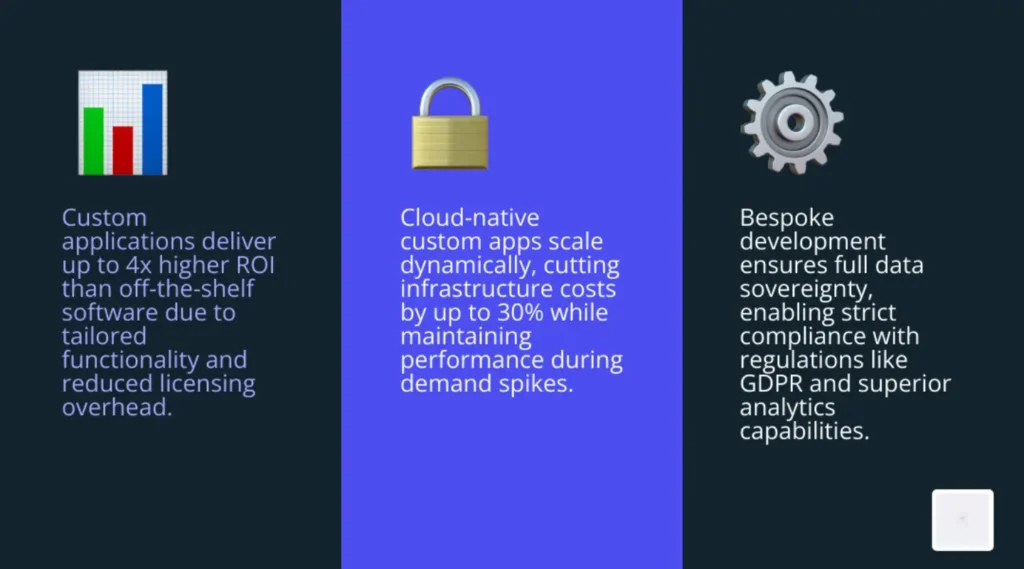
A key advantage of custom solutions lies in data ownership and control. With bespoke applications, businesses maintain complete sovereignty over their data, enabling robust analytics, improved security, and compliance with evolving regulations like GDPR. This level of control is often diluted or complicated with third-party, off-the-shelf software, where data structures and access policies are dictated by the vendor. For companies aiming to leverage their data as a strategic asset, custom development provides the necessary foundation for advanced analytics and informed decision-making.
Scalability Advantages in Custom Mobile and Web App Development
Scalability is paramount for any digital solution in August 2026, where business demands can fluctuate rapidly. Custom mobile and web applications, when designed with modern architectural principles, offer inherent scalability advantages that generic software often cannot match. By embracing cloud architecture, businesses can dynamically adjust computing resources to meet demand, ensuring seamless performance during peak loads and cost efficiency during quieter periods. This flexibility is a cornerstone of a future-ready digital infrastructure.
The adoption of microservices architecture further enhances scalability and resilience. Instead of a monolithic application, microservices break down an application into smaller, independent services that can be developed, deployed, and scaled independently. This modularity not only simplifies maintenance and updates but also improves fault isolation, meaning a failure in one service does not bring down the entire application.
An API-first design approach is another critical element. By prioritizing Application Programming Interfaces (APIs), custom applications become inherently more interconnected and adaptable. APIs enable seamless communication between different systems, both internal and external, fostering an ecosystem of integrated services.
Postman’s recent survey revealed a 3% increase in companies adopting an API-first approach in the last year, underscoring its growing importance for faster time-to-market, enhanced user experiences, and greater scalability. This approach allows businesses to build robust, extensible systems that can easily integrate with emerging technologies and third-party services, ensuring long-term relevance and adaptability.
Tailored User Experience and Customer Engagement
In an era where customer expectations are constantly rising, a tailored user experience (UX) is no longer a luxury but a necessity. Custom mobile and web applications allow businesses to design intuitive, engaging, and highly personalized experiences that resonate deeply with their target audience. This focus on the user journey is a powerful differentiator, fostering stronger customer engagement and loyalty.
Omnichannel design ensures that the brand experience is consistent and seamless across all customer touchpoints – whether on a mobile app, web browser, or in-store digital kiosk. This unified approach projects the brand clearly across the many devices and channels customers use.
By mapping user journeys, businesses can identify pain points and optimize workflows within their custom applications, streamlining interactions and enhancing satisfaction. The result is a frictionless experience that meets and often exceeds customer expectations. Research shows that 46% of organizations are better able to meet customer experience expectations when they leverage digital advancements.
Beyond customer-facing applications, custom development can also optimize internal workflows, leading to significant improvements in employee experience and productivity. By designing tools that mirror specific operational processes, businesses can eliminate inefficiencies, reduce training time, and empower their teams with precisely what they need to succeed. This dual focus on external customer engagement and internal operational efficiency drives comprehensive brand differentiation and competitive advantage.
Enhancing Operational Efficiency and Enterprise Security
Operational efficiency and robust enterprise security are two sides of the same coin in the digital age. Custom mobile and web app development offers a unique opportunity to embed these critical elements directly into the core of business operations, rather than treating them as afterthoughts. By designing applications from the ground up with specific processes and security requirements in mind, organizations can achieve unparalleled levels of performance and protection.
Process automation, facilitated by custom applications, can transform labor-intensive tasks into streamlined, error-free operations. This not only frees up human capital for more strategic activities but also ensures consistency and speed. For instance, AI-based processes enable worker productivity, with 52% of organizations reporting improvements in this area.
Data protection is another cornerstone of custom development. By implementing advanced encryption, access controls, and data governance policies directly within the application architecture, businesses can safeguard sensitive information more effectively. This is particularly vital given that 82% of IT security and C-level executives experienced at least one data breach when implementing new technologies and expanding their supply chain.
Zero-trust security models, where no user or device is inherently trusted, can be meticulously integrated into custom applications. This approach mandates strict verification for every access request, regardless of whether it originates inside or outside the network perimeter. Coupled with comprehensive compliance governance, custom solutions ensure that applications adhere to industry regulations and internal policies, minimizing legal and reputational risks.
Mitigating Cyber Risks in Tailored Digital Ecosystems
The increasing sophistication of cyber threats necessitates a proactive and integrated approach to security. Custom mobile and web applications, by their very nature, allow for the embedding of advanced security measures tailored to the specific risk profile of the organization. This contrasts sharply with off-the-shelf solutions, which often offer generic security features that may not fully address unique vulnerabilities.
Threat intelligence can be directly integrated into custom applications, enabling real-time monitoring and rapid response to emerging threats. This means the application can learn and adapt its defenses, providing a dynamic shield against malicious activities. API security, crucial for interconnected systems, can be hardened through custom authentication, authorization, and encryption protocols, protecting data in transit and at rest.
Data compliance, including adherence to regulations like GDPR and CCPA, can be built into the application’s data handling processes from inception. This ensures that personal data is collected, stored, and processed in a manner that respects user privacy and legal mandates.
Furthermore, role-based access controls (RBAC) can be finely tuned within custom applications, granting users only the minimum necessary permissions to perform their duties. This principle of least privilege significantly reduces the attack surface and mitigates the impact of potential breaches. By integrating these robust security measures, custom solutions transform cybersecurity from a reactive necessity into a core business enabler.
Accelerating Cross-Functional Workflows and Data Visibility
In complex organizations, siloed data and disjointed workflows can severely impede efficiency and decision-making. Custom mobile and web applications are uniquely positioned to break down these barriers, accelerating cross-functional workflows and enhancing data visibility across the enterprise. By designing integrated systems, businesses can ensure that information flows seamlessly between departments, fostering collaboration and enabling a holistic view of operations.
Advanced analytics capabilities can be embedded directly into custom applications, allowing users to extract meaningful insights from vast datasets in real-time. This is supported by robust data pipelines that collect, process, and transform data from various sources into a unified format.
The result is a significant improvement in business intelligence, empowering employees at all levels to make data-driven decisions. Research indicates that 49% of organizations are better able to manage business performances through data availability, highlighting the critical role of integrated data ecosystems.
System integration, a core strength of custom development, ensures that new applications can communicate effectively with existing legacy systems and third-party tools. This creates a cohesive digital environment where data is accessible and actionable, eliminating manual data entry and reconciliation errors. By optimizing these cross-functional workflows and providing enhanced data visibility, custom solutions not only boost operational efficiency but also foster a culture of transparency and agility, essential for rapid market response and continuous innovation.
Building Future-Ready Systems with Modern Technology Stacks
The rapid pace of technological evolution means that today’s solutions must be designed with an eye toward tomorrow. Custom mobile and web app development, when executed with modern technology stacks, inherently builds future-ready systems capable of adapting to emerging trends and integrating cutting-edge innovations. This approach ensures that digital investments provide lasting value and a competitive edge for years to come.
Modern technology stacks leverage components like data lakes for storing vast amounts of raw data, facilitating advanced analytics and AI applications. Platform engineering focuses on building robust, scalable foundations that accelerate the development and deployment of new features and services.
Cloud-native deployment, which involves designing applications specifically for cloud environments, offers unparalleled agility, resilience, and scalability. Collaborating with an experienced digital product development company ensures these elements collectively form a powerful framework for modern systems, making applications not just functional but inherently adaptable and extensible.
Companies that embrace these advanced architectural patterns are better positioned to respond to market shifts, launch innovative products, and maintain a leading position. This proactive approach to technology ensures that the digital infrastructure serves as a strategic asset, continuously driving growth and competitive advantage.
Integrating Enterprise AI into Custom Mobile and Web App Development
Artificial Intelligence (AI) is no longer a futuristic concept but a present-day imperative for enterprise applications. Custom mobile and web app development provides the ideal canvas for seamlessly integrating enterprise AI capabilities, transforming operations, and unlocking new forms of value. From predictive modeling to intelligent automation, AI can be tailored to address specific business challenges and opportunities.
Predictive modeling, powered by machine learning algorithms, can be embedded into custom applications to forecast trends, anticipate customer behavior, and optimize resource allocation. For example, in digital commerce, recommendation systems evolve based on micro-behaviors, testing, adapting, and optimizing in milliseconds to maximize conversions.
Natural Language Processing (NLP) can enable applications to understand and process human language, enhancing customer service through intelligent chatbots and improving data analysis from unstructured text. In banking, insurance, and healthcare, NLP and its processing applications are becoming the silent workhorse behind faster decisions and better customer experiences.
Intelligent automation, driven by AI, can automate complex business processes, from data entry to decision-making, significantly boosting efficiency and reducing human error. AI-based processes enable worker productivity, with 52% of organizations reporting enhanced productivity. Custom development allows for the strategic identification of AI use cases, business case development, and the design of pilot programs, ensuring that AI integration delivers tangible, measurable impact tailored to the organization’s unique needs.
Adopting Agile Delivery and Incremental Engineering
The traditional waterfall approach to software development, with its long cycles and rigid requirements, is ill-suited for the demands of digital innovation. Custom mobile and web app development thrives on agile delivery and incremental engineering methodologies, which prioritize flexibility, collaboration, and continuous improvement. This approach allows businesses to adapt quickly to changing market conditions and user feedback.
Agile methodologies break down projects into smaller, manageable sprints, delivering working software in short iterations. This allows for continuous integration and continuous delivery (CI/CD), where code changes are frequently merged and deployed, reducing risks and accelerating time-to-market. Minimum Viable Product (MVP) deployment is a core tenet of this approach, allowing businesses to launch a basic version of their application quickly, gather real-world feedback, and iterate based on user needs.
Rapid prototyping further accelerates the development cycle, enabling teams to quickly test and validate ideas before committing significant resources. This “fail-fast” approach, where new ideas are encouraged, failure is tolerated, and successes are rewarded, is crucial for fostering an innovation culture. By adopting agile practices, organizations can ensure that their custom applications evolve in lockstep with business needs, delivering continuous value and maintaining competitive relevance.
Measuring Business Outcomes and Software ROI
Investing in custom mobile and web app development is a strategic decision that demands clear measurement of business outcomes and return on investment (ROI). Unlike off-the-shelf solutions with predefined metrics, custom applications allow for the establishment of highly specific KPIs that directly align with an organization’s strategic goals, ensuring that every development effort contributes to tangible business value.
Measuring success goes beyond mere technical functionality. It encompasses improvements in revenue growth, reductions in total cost of ownership (TCO) through optimized processes, and decreases in cycle time for key operations. For example, 66% of organizations report significant growth in profitability from effectively using technology to advance their business.
Key digital transformation metrics typically include:
- Customer Acquisition Cost (CAC): How much it costs to acquire a new customer through digital channels.
- Customer Lifetime Value (CLTV): The predicted revenue a customer will generate over their relationship with a company.
- Conversion Rate: The percentage of users who complete a desired action (e.g., purchase, sign-up).
- Employee Productivity Gains: Measured by time saved on tasks or increased output per employee.
- Operational Cost Reduction: Savings achieved through automation and process optimization.
- Time to Market (TTM): The speed at which new products or features are released.
- System Uptime and Performance: Reliability and responsiveness of the application.
- Data-Driven Decision Making (DDD): The extent to which business decisions are informed by data analytics.
By meticulously tracking these and other relevant metrics, businesses can demonstrate the concrete value delivered by their custom applications, justify ongoing investment, and continuously optimize their digital strategy.
Establishing Key Value Drivers and Performance Metrics
To effectively measure the success of custom mobile and web applications, it’s crucial to identify the key value drivers and establish precise performance metrics upfront. These drivers should directly link the application’s features to strategic business objectives, providing a clear roadmap for evaluation.
Customer retention is a primary value driver, often improved by a superior, personalized user experience offered by custom apps. Metrics like churn rate, repeat purchase rate, and Net Promoter Score (NPS) can quantify this impact. Operational agility, another critical driver, can be measured by metrics such as process cycle time, response time to market changes, and the speed of feature deployment. Custom applications, designed for specific workflows, inherently enhance this agility.
Conversion rates, whether for sales, lead generation, or specific user actions, are direct indicators of an application’s effectiveness in achieving business goals. A custom-tailored interface and optimized user journey can significantly boost these rates. Finally, uptime reliability and system responsiveness are fundamental performance metrics that ensure continuous operation and user satisfaction.
Custom solutions, built with robust architectures and proactive monitoring, can guarantee higher levels of reliability compared to generic software. By focusing on these specific metrics, organizations can gain a clear understanding of their custom application’s contribution to overall business success.
Overcoming Implementation Hurdles and Cultural Shifts
While the benefits of custom mobile and web app development are compelling, successful implementation is not without its challenges. Only about 30% of companies navigate a digital transformation successfully, highlighting the need for careful planning and strategic execution. A significant hurdle often lies in managing the cultural shifts required to embrace new digital tools and ways of working.
Change management is paramount. Employees may resist new systems due to fear of the unknown, perceived complexity, or concerns about job security. Effective change management involves clear communication, comprehensive training, and demonstrating the tangible benefits of the new applications to end-users. Workforce upskilling and digital literacy initiatives are essential to equip employees with the necessary skills to leverage new technologies effectively. Research shows that 9 out of 10 organizations report a lack of necessary skills to drive successful digital transformation projects, underscoring this critical need.
Cross-departmental buy-in and strong leadership commitment are also vital. Digital innovation is a business transformation, not just an IT project. It requires aligning stakeholders across the organization, fostering collaboration, and ensuring that the digital strategy is deeply integrated with the overall business strategy. By addressing these human and organizational factors proactively, businesses can overcome implementation hurdles and cultivate a digital culture where innovation thrives.
Frequently Asked Questions About Custom Application Engineering
How does custom development improve long-term ROI compared to off-the-shelf tools?
Custom development significantly enhances long-term ROI by providing tailored functionality that precisely meets unique business needs, eliminating the compromises inherent in off-the-shelf software. While initial development costs might be higher, custom solutions avoid recurring licensing fees and offer complete control over features, allowing for continuous optimization and adaptation.
This bespoke functionality translates into higher operational efficiency, better user experiences, and a stronger competitive edge. Furthermore, custom applications are built with platform scalability in mind, meaning they can grow and evolve with the business without requiring costly migrations or limitations imposed by vendor roadmaps. This long-term adaptability and ownership of intellectual property ensure that the investment continues to deliver value and drives sustainable growth.
What security standards should enterprise custom software follow?
Enterprise custom software must adhere to stringent security standards to protect sensitive data and maintain operational integrity. Key standards include robust data encryption for data at rest and in transit, ensuring that information is unreadable to unauthorized parties. Compliance frameworks such as GDPR, HIPAA, ISO 27001, and PCI DSS (depending on the industry) must be integrated into the application’s design and development lifecycle.
Regular vulnerability testing, including penetration testing and security audits, is essential to identify and remediate weaknesses. Finally, secure protocols for authentication (e.g., multi-factor authentication), authorization (e.g., role-based access control), and secure API communication must be implemented. Integrating threat intelligence and continuous monitoring further strengthens the security posture, moving towards a proactive, zero-trust model.
How long does an enterprise-grade custom app typically take to deploy?
The deployment timeline for an enterprise-grade custom app varies significantly based on complexity, scope, and the chosen development methodology. However, modern approaches like agile and incremental engineering aim to deliver value much faster than traditional methods. Instead of a single, long deployment, custom apps are typically developed and deployed through iterative sprints, with functional modules released progressively.
An MVP (Minimum Viable Product) can often be deployed within a few months, providing core functionality and allowing for early user feedback. Subsequent features are then added through modular rollout, ensuring continuous improvement and adaptation. Rigorous testing cycles are integrated throughout each sprint and before each release, ensuring quality and stability. While a full-featured enterprise application might take 9-18 months or more to mature, businesses can start realizing value from an MVP much sooner.
Conclusion: Engineering Sustainable Digital Advantage
In the rapidly evolving digital landscape of August 2026, the ability to innovate and adapt is no longer optional—it is a prerequisite for survival. The statistics are clear: companies that fail to innovate will ultimately face decline. Custom mobile and web app development offers a powerful pathway to engineering sustainable digital advantage, moving beyond generic solutions to create bespoke tools that perfectly align with an organization’s strategic goals.
By investing in custom applications, businesses gain unparalleled control over their digital destiny. They can build systems that offer superior scalability, deliver tailored user experiences, enhance operational efficiency, and embed robust security from the ground up. This approach fosters an innovation culture where new ideas are encouraged and supported, enabling continuous improvement and rapid response to market demands.
The journey toward digital excellence is complex, involving strategic adaptability, continuous innovation, and a commitment to technical excellence. However, with custom development, organizations can build future-ready systems that not only address current needs but also lay the foundation for long-term sustainability and competitive leadership. It’s about crafting a digital future that is uniquely yours, driving growth and ensuring relevance in an ever-changing world.