How to Conduct a Thorough Risk Assessment for Temporary Access Structures
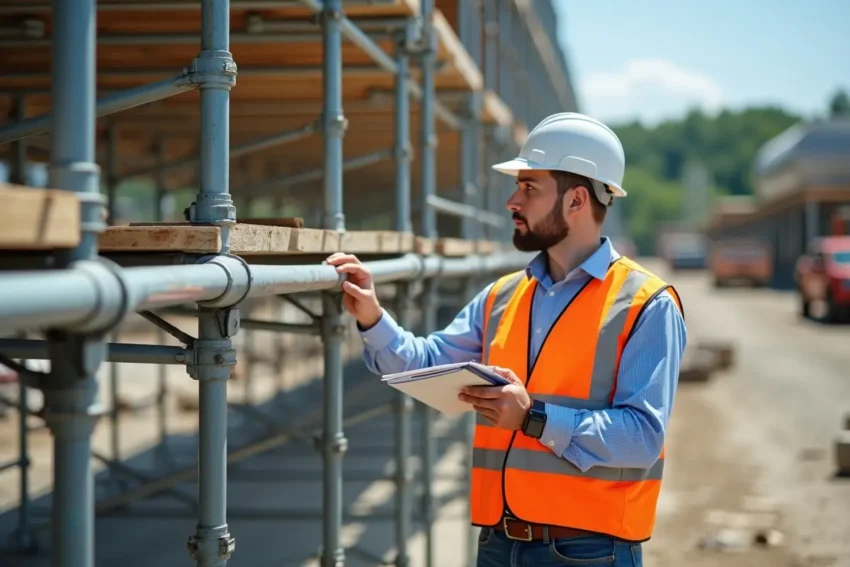
Having a risk assessment done once and leaving it in a folder somewhere doesn’t really ‘do’ anything, but it does count as a paper tick in the process box for having an assessment.
The problem isn’t that there was no assessment of the risk of scaffold incidents, it’s that the assessment was carried out under the premise that the structure would be stationary even though the danger is in movement. And every time that tower gets picked up and repositioned, the profile of risk is technically supposed to reset, because clearly the environment has changed.
Contents
Start With Site Hazards Before You Think About Equipment
It is essential to conduct a manual site survey before making any decisions about the type of equipment you will deploy on a job. Overhead power lines, fragile roof surfaces, slopes, soft ground, and high-traffic pedestrian routes are not minor considerations. In fact, they are the criteria that will determine the equipment you cannot use.
Site conditions including ground type are more critical than most managers factor in. Soil, tarmac, and an internal concrete floor may look solid but have distinctly different load capacities. A scaffold leg transferring point loading through a base plate onto a surface that can’t take it is not a scaffold problem. It’s a site selection problem that your design should have trapped before you started to assemble.
At this point, you can also define your exclusion zone. If the public is within reach of the structure, you need a pre-planned, marked, and recorded cordoned area before the first section goes up. A risk assessment that doesn’t identify local public and their risk of injury isn’t finished.
Load Calculations Aren’t Guesswork
Each temporary access structure has a rated working load. Your responsibility is to calculate the realistic peak demand, workers, tools, materials, debris, and confirm that the rated load exceeds it with a margin. Don’t calculate for average use. Calculate for the worst realistic moment of the day.
People do and die because of dynamic load. A structure that handles the static weight of two workers and their tools can behave differently when those workers are moving, shifting materials, or when wind loading adds lateral force. If your assessment only captures the static numbers, it’s missing the conditions that actually cause failures.
For most of the tasks where tube-and-fitting is still the default choice, the risk could be eliminated using something like a mobile tower scaffold. Those square-sectioned, band-and-triggered wheels mean the structure itself is designed with the constant need to reposition in mind and, far more important, slab loading and stabilizing are engineered in. That’s the right tool for tasks where repositioning is unavoidable. A tube-and-fitting system built into an ad-hoc mobile scaffold is not a mobile scaffold. It’s a death trap.
The Inspection Schedule Has to be Mandatory, Not Advisory
Accidents involving falls from a height continue to be the most significant cause of deaths at work in the construction industry. In 2022/23 they were responsible for 33% of all fatal injuries (HSE, Health and Safety at Work, 2023). If that statistic is to change, it needs the discipline of regular inspections.
The regime in your schedules should be that it must be inspected as a one-off when it is first erected, and then every seven days after that. It must also be inspected after any event likely to have put its structural integrity at risk, perhaps after vehicle impact or particularly bad weather. And after any modification, the structure must be assessed again to ensure it still complies.
These checks are not there for you to choose to ignore; they are the points when a structure that met your required standard at the previous check could otherwise remain standing when it has now silently become non-compliant. The legislation requires that it shall be inspected by a competent person at suitable intervals and, where appropriate, in certain circumstances. The same regulations say the “competent person” must have sufficient training, instruction, knowledge or experience appropriate to the nature of the work equipment and the risks involved. For mobile access towers, the trade body PASMA has put that training in place. Having spent longer on-site than anyone else is not the same thing.
Collective Protection Comes Before PPE
Personal protective equipment is the last line of defense. It’s not the plan. Your risk assessment should prioritize collective fall prevention, guardrails, toe boards, fully boarded platforms, over harnesses and fall arrest systems. If your assessment skips straight to “workers will wear harnesses,” it’s working backwards.
Double guardrails are standard on any working platform above two metres. Toe boards prevent tools and materials from being kicked off the edge. These aren’t optional enhancements, they’re the baseline.
The 3T Method (Through the Trap) applies specifically to tower scaffold assembly and should be called out explicitly in any assessment involving that equipment type. It protects the person doing the build, not just the people using it after. If the method isn’t referenced in your documentation, the assessment hasn’t accounted for the assembly phase as a distinct risk period.
Environment and Movement Are Connected Risks
Wind loading changes as you get higher. Something that’s steady at a height of three metres may wobble when it’s doubled. Your assessment needs to make specific reference to the manufacturer’s guidance on when outriggers or stabilizers are required based on the height of the working platform and the prevailing wind speed on the day.
The same goes for gradients. Most manufacturers detail the maximum slope or gradient that’s permissible when using mobile access equipment. If the site gradient is outside these limits, then outriggers it is.
What turns a worthwhile assessment into a proper one is that it treats repositioning the structure as an activity in its own right, not just a footnote two lines below the job is finished. Every time a tower is moved even a short distance you need to consider the new surface conditions, the closer proximity to the edge or other hazards and how materials will be passed up.
Risk assessment doesn’t precede temporary access, it accompanies the structure for as long as it’s in place.